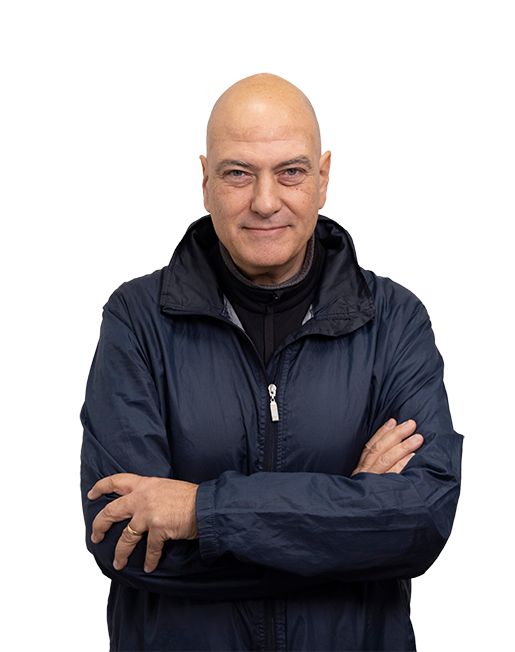
Gianluca
Murasecchi
He was born in Spoleto in 1965 and graduated in Painting from the Academy of Fine Arts in Rome in 1986. After spending extended periods studying in Brussels, Algiers, Geneva and Tallinn, he moved permanently to Rome, where he set up his studio. He has been teaching Graphic Art – Engraving Techniques and Illustration at the Academy of Fine Arts in Rome since 2018.
To find out more about Gianluca Murasecchi, please see the PDF:
Three-year course
1st and 2nd year
- Historical, critical and technical notes on ancient and modern Graphics.
- Drypoint, etching, soft ground etching, aquatint, sugar lift, mezzotint, woodcut using fine-grained wood, PVC linoleum.
- Drawings for engraving / Printing methods / Arrangement of tools in a chalcographic workshop and use of woodcut and chalcographic presses / Matrix preparation / Beveling and smoking.
- Direct engraving / Drypoint / Punch / Electric cutters and hammers / Sharpening and use of tips / Use of the burnisher / Preparation of chalcographic inks / Use of printing papers / Wetting and drying of paper / Transfer of the drawing to the matrix / Woodcut on PVC and linoleum.
- Indirect engraving / Etching, soft wax, aquatint techniques on zinc, copper / Preparation of acids for etching / Flat etching / Etching for covers / Palm printing / Hot and cold inking / Negative, positive and background printing / Aquatint with rosin, with Jewish bitumen, synthetic spray, salt grain.
- Production of study drawings in the designated sketchbook / At least 10 enlarged drawings (ink, pen, charcoal, graphite, etc.) approved by the lecturer, relating to preliminary studies on 50 x 70 cm paper, for studies involving digital processing and photographic post-production with graphic interventions / 60 x 80 cm format for original works (drawings, graphic and pictorial techniques, collages, etc.) / For the first year of the course, the formats are reduced to 35 x 50 cm.
- Production of at least 4 original chalcographic prints with a minimum matrix size of 35 x 50 cm / Or a series of plates covering at least this area of the work / For the first year of the course, the sizes are reduced to 25 x 17.5 cm.
3rd year
- Critical and technical notes on international contemporary Graphics, detailed research on artists, art galleries, exhibitions and museums of recognised value.
- Associated techniques / drypoint on cardboard or plexiglass / Direct oil pastels or on aquatint.
- Printing with a base plate / Soft paint and application of materials on wax / Punch of various shapes / Lapis manner (direct or indirect wheel) / Black manner – classic with impure berceau with drypoint / Double-printed prints / Polychrome print / French method (stencil printing) with preliminary preparation of the base plate of the register / English method (poupè) inking by zones in the same matrix / Monotypes / classic burin technique on copper or woodblock / Matrices for dry prints.
- Production of at least 6 original chalcographic prints, 4 with a minimum matrix size of 35 x 50 cm / 2 plates with a minimum size of 50 x 70 cm / or a series of matrices printable on paper sizes of 50 x 70 cm or 100 x 70 cm respectively.
- Dry printing with various materials / Woodblock or linoleum / PVC on a print size of 100 x 70 cm.
- Proposals for experimental and innovative techniques are allowed.
Use of the drill on matrices – metal – wood – plastic / Use of various matrices (cardboard, wood, plastic) / Use of the pyrograph on matrices – wood – plastic / Use of the vibro-engraver on metal matrices / Application of metal pastes (carborundum), various adhesives / Relief engraving / Printing on fabric of medium or large formats / Colour woodcut / Hand printing with a baren / Chalcographic photoengraving / Photo-reproduction on a printing sheet and printing with the Art Graphics technique / Scratched slide, etc. - Production of at least 10 enlarged drawings (drawings approved by the lecturer relating to preliminary studies) on 100 x 70 cm paper (unless variations are agreed with the lecturer regarding the number, formats and techniques used) / Those who will work with digital techniques or mixed media may produce 10 works on 70 x 50 cm paper (unless variations are agreed with the lecturer regarding the number, formats and techniques used).
- Preparation and completion of the artistic project to be presented during the thesis discussion phase. The artistic project can be carried out in any medium as long as it is consistent with the poetics to be expressed: projects created with the aid of video projections, performances, original drawings on macro-formats, artist’s books, photographs or photographic techniques, photo collages, digital collages, sequences of art prints, experimental techniques, etc. are therefore permitted.
Materials
Enrolment on the course allows the use of engraving and printing tools (press, inks, tarlatane, acids, special varnishes, etc.) only in the presence of the teacher and tutors.
Consumables (plates, printing paper, special inks, tarlatan, solvents, rags, cleaning paper, etc.) and personal equipment are not provided by the Academy.
Materials required, mandatory or recommended for work in the workshop
- Zinc or copper plates for engraving, at least 13 x 18 cm in size. + One ball of etching wax and one ball of soft wax.
- A bottle of high-opacity covering for engraving.
- A multi-wick candle for engraving.
- Common bristle brushes with a round and flat section in various sizes.
- Sheets of Hahnemühle light-weight printing paper, size 50×70 cm.
- Sheets of Fabriano paper, 100×70 cm.
- A roll of adhesive tape for packaging.
- Sheets of abrasive paper for metals (800, 1,000, 1,200).
- Steel pencils for engraving in various shapes.
- A scraper-polisher.
- A notebook for preliminary studies and projects.
- A rigid cardboard folder, size 50×70 cm.
- Plenty of rags.
- A cutter.
- At least one litre of white spirit.
- At least one litre of denatured alcohol.
- Spanish or Paris whites to degrease the metal matrices for each metal engraving session.
Accident Prevention Regulations:
Personal equipment:
- acid and solvent-resistant mask,
- anti-dust mask,
- acid-resistant neoprene gloves.
Students who suffer from proven and documented allergies related to the substances used in the workshops (in particular solvents, alcohol, bitumen and rosin, iron perchloride, nitric acid) are required to inform the Lecturer, the Workshop Technician and the Tutor.
Recommended basic reading list:
G. Maffei, Il libro d’artista, ed. Sylvestre Bonnard, Milan, 2003 Various authors, Le tecniche artistiche, ed. Mursia, Milan, 1981
Various authors, La xilografia, ed. De Luca, Rome, 2001
Various authors, Bulino, puntasecca, maniera nera. Le tecniche calcografiche d’incisione diretta, Ed. De Luca, Rome, 2003
Various authors, Acquaforte, acquatinta, lavis, vernice molle. Le tecniche d’incisione calcografica indiretta, Ed. De Luca, 2005;
Guido Strazza, Il Segno e il Senso, ed. De Luca, Rome 2023.
Exam procedures:
The exams will consist of a public presentation, either in the classroom or online, of students’ expressive, conceptual and technical work.
In view of the current health emergency relating to Covid-19, this programme is subject to change.
Following the conclusion of the presentations, the results will be confirmed privately.
Programme
Themes
In the Illustration course, students will be required to experiment with creative writing by producing a text that, for the 2023/2024 academic year, will focus on the themes: “Memory”and “The Infinite”. The lecturer will edit the proposed texts.
The narrative will be illustrated by the students in a deluxe edition containing at least five original panels. The projects to be considered will primarily be artist’s books, graphic novels or works containing a greater number of illustrations (compared to the minimum requirement of 5 panels).
For those who do not wish to experiment with a creative writing study (the creative writing course is open only to students of Graphic Design who wish to undertake this exercise), the suggestion is to illustrate one of the short stories by Dino Buzzati attached to the digital course material on the TEAMS platform.
The edition containing the original works will then be scanned and at least 3 digital copies will be printed in a smaller format than the copy containing the originals, one of which will be kept in the Illustration course archive. If any students are unable to provide a copy containing the originals, the illustrations on loose sheets will be scanned and the edition will be laid out for printing in three hard copies.
The production of 5 works in the format 35×50 cm is also required, created with the same technique and visual poetics chosen for the production of the panels included in the printed edition, but which may depict themes other than those related to the edition.
Attendance
Compulsory attendance is 4/5 of the duration of the course, i.e. 80% of the lessons.
Purpose
The illustration course aims to train young artists to successfully showcase their work in art galleries that also promote artist’s books, as well as with art publishers and professional commercial publishers, by developing and enhancing each student’s unique qualities in an original and distinctive way. During the first semester, a series of sessions will be scheduled to review the work produced in the recent past by each student and to identify a way of synthesising the techniques best suited to the various students. There will be no restrictions on the techniques to be used; these will be selected and agreed with the lecturer on a case-by-case basis. The course is primarily aimed at designing publications intended for readers aged 14 and over, although projects aimed at a younger age group will also be considered with the utmost care. As part of the course, students will be informed of any contests they may wish to enter. By the end of the course, each student should then have completed a project suitable for presentation to professionals in the sector.
Lecture topics
Review of work in progress and Illustration workshop.
Classroom lectures will be held at the beginning of each Thursday’s lesson. The lessons will focus on the history of international illustration, experimental publications by international artists, the study of characters, drawing under the supervision of the lecturer, the language of storytelling and fairy tales,
contemporary illustration, works of art within publishing contexts, the study of techniques used by historical illustrators, textures, light and shading, visual communication, copyright, creative thinking, marketing, photography, etc.
The techniques used will be decided on a case-by-case basis and will range across all suitable methods, such as: graphite, coloured pencils, Indian ink, pen, watercolour, tempera, acrylic, oil, oil-based wax pastels, chalk, pantone colours, etc., as well as digital techniques; in other words, the choice of techniques will be determined by the style, the target audience and the individual’s artistic vision.
Exam format
Exams will consist of a public presentation, either in class or online, of students’ expressive, conceptual and technical research. Preliminary designs will also be assessed prior to the finalisation of the project.
Following the conclusion of the presentations, the results will be confirmed.
Passing the exam entitles the student to 6 CFA credits for the three-year course.
Recommended basic reading list
– Come creare un portfolio e trovare lavoro, by Fig Taylor, 2014 Logos Paperback, 160 pages.
– Illustrazione – L’immaginario per professione, by Alessandro Bonaccorsi, 2013 Alkemia Books.
– How to be an illustrator, by Darrel Rees 2008 Laurence King Pub. – New Edition, 2014 Paperback, 160 pages.
– ARTInc., by Lisa Congdon, 2014 Chronicle Books, Paperback, 184 pages – Available as an ebook.
– The Education of an Illustrator, by Steven Heller and Marshall Arisman, 2000 Allworth Press, Paperback, 294 pages.
– Il mondo incantato by Bruno Bettelheim, Ed. Feltrinelli.
Programme
Themes
In the Illustration course, students will be required to experiment with creative writing by producing a text that, for the 2023/2024 academic year , will focus on the themes: “Sacrifice” or “The Afterlife”. The lecturer will edit the proposed texts.
The narrative will be illustrated by the students in a deluxe edition containing at least five original panels. The projects to be considered will primarily be artist’s books, graphic novels or works containing a greater number of illustrations (compared to the minimum requirement of 5 panels).
For those who do not wish to experiment with a creative writing study (the creative writing course is open only to students of Graphic Design who wish to undertake this exercise), the suggestion is to illustrate one of the short stories by Jorge Luis Borges contained in the collection “L’Aleph”, from 1949, or, for students on the Erasmus project, one of the short stories by the Brothers Grimm “Fairy Tales”. The aforementioned stories are added to the digital course material on the TEAMS platform.
The edition containing the original works will then be scanned and at least 3 digital copies will be printed in a smaller format than the copy containing the originals, one of which will be kept in the Illustration course archive. If any students are unable to provide a copy containing the originals, the illustrations on loose sheets will be scanned and the edition will be laid out for printing in three hard copies.
The production of 5 works in the format 100×70 cm or not less than 70×50 cm is also required, created with the same technique and visual poetics chosen for the production of the panels included in the printed edition, but which may depict themes other than those related to the edition.
Attendance
Compulsory attendance is 4/5 of the duration of the course, i.e. 80% of the lessons.
Purpose
The illustration course aims to train young artists to successfully showcase their work in art galleries that also promote artist’s books, as well as with art publishers and professional commercial publishers, by developing and enhancing each student’s unique qualities in an original and distinctive way. There will be no restrictions on the techniques to be used; these will be selected and agreed with the lecturer on a case-by-case basis. The course is primarily aimed at designing publications intended for readers aged 14 and over, although projects aimed at a younger age group will also be considered with the utmost care. As part of the course, students will be informed of any contests they may wish to enter. By the end of the course, each student should then have completed a project suitable for presentation to professionals in the sector.
Lecture topics
Review of work in progress and Illustration workshop.
Classroom lectures will be held at the beginning of each Thursday’s lesson. The lessons will focus on the history of international illustration, experimental publications by international artists, the study of characters, drawing under the supervision of the lecturer, the language of storytelling and fairy tales, contemporary illustration, works of art within publishing contexts, the study of techniques used by historical illustrators, textures, light and shading, visual communication, copyright, creative thinking, marketing, photography, etc.
The techniques used will be decided on a case-by-case basis and will range across all suitable methods, such as: graphite, coloured pencils, Indian ink, pen, watercolour, tempera, acrylic, oil, oil-based wax pastels, chalk, pantone colours, etc., as well as digital techniques; in other words, the choice of techniques will be determined by the style, the target audience and the individual’s artistic vision.
Exam format
Exams will consist of a public presentation, either in class or online, of students’ expressive, conceptual and technical research. Preliminary designs will also be assessed prior to the finalisation of the project.
Following the conclusion of the presentations, the results will be confirmed.
Recommended basic reading list
– Come creare un portfolio e trovare lavoro, by Fig Taylor, 2014 Logos Paperback, 160 pages.
– Illustrazione – L’immaginario per professione, by Alessandro Bonaccorsi, 2013 Alkemia Books.
– How to be an illustrator, by Darrel Rees 2008 Laurence King Pub. – New Edition, 2014 Paperback, 160 pages.
– ART Inc., by Lisa Congdon, 2014 Chronicle Books, Paperback, 184 pages – Available as an ebook.
– The Education of an Illustrator, by Steven Heller and Marshall Arisman, 2000 Allworth Press, Paperback, 294 pages.
– Il mondo incantato by Bruno Bettelheim, Ed. Feltrinelli.