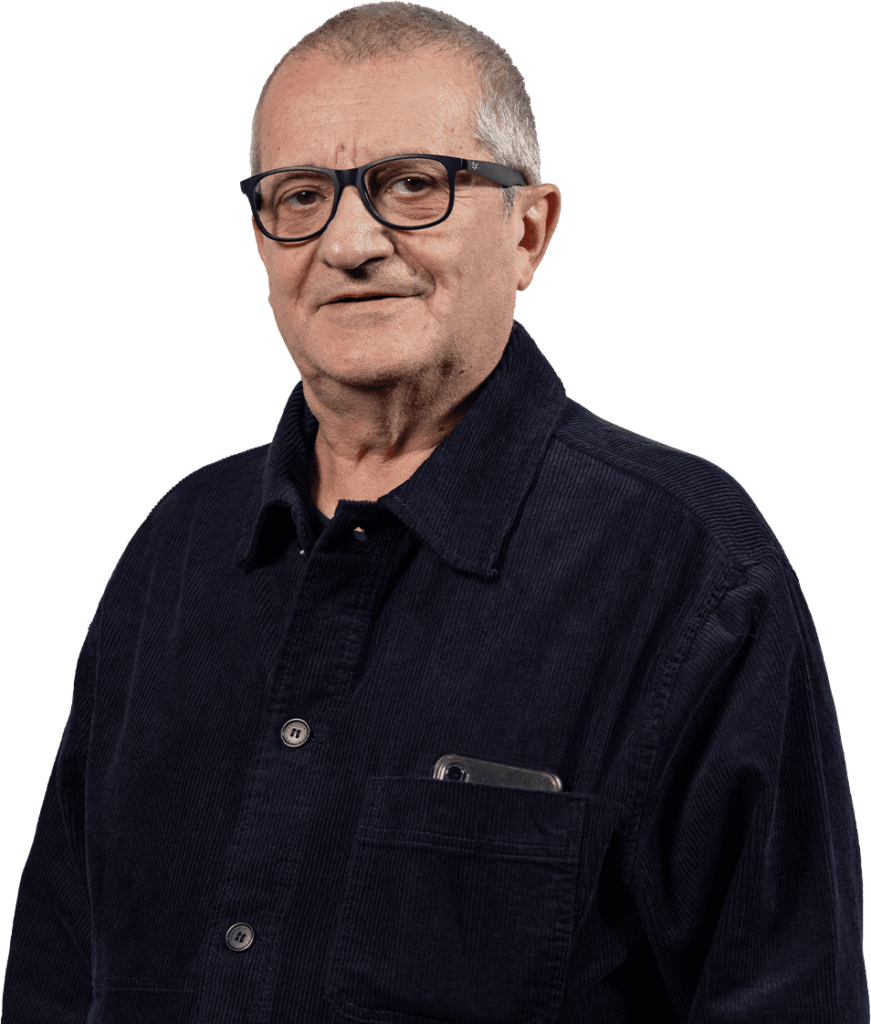
Giovanni
Albanese
Lecturer in Cinematography 1 and 2.
In 2022, he worked on his film ‘Vita Morte e Miracoli’
DIRECTED by: Giovanni Albanese
Story: Giovanni Albanese, Valerio Attanasio, Simone Oggionni
Screenplay: Valerio Attanasio, Giovanni Albanese
Lead actor: Stefano Fresi
Talent agency: Sosia and Pistoia
(In development)
In 2011, his film ‘Senza arte ne parte’ was released in cinemas.
PRODUCTION: Rai Cinema and Lumière.
DISTRIBUTION: 01.
DIRECTED by Giovanni Albanese
Screenplay by Giovanni Albanese and Fabio Bonifacci, music by Mauro Pagani
Starring: Vincenzo Salemme, Giuseppe Battiston, Donatella Finocchiaro (David 2012, 2009, 2007) (Nastro d’Argento 2012), Hassani Shapi
Italian HD Trailer for Senza Arte Né Parte – TopCinema.it …‘Senza Arte Né Parte’ received TWO NASTRI D’ARGENTO NOMINATIONS for Best Comedy and Best Leading Actor.
Giuseppe Battiston won the Nastro d’Argento for Best Leading Actor.
In the same year, the film won the Cinema e Territori Award at the 3rd edition of the Otranto Film Fund Festival. The film has been invited to various film festivals in Italy and across Europe.
In 2014, it was the closing film at the Cannes Film Festival.
In 2010, he directed a series of episodes of the TV series ‘Un Posto al Sole’
PRODUCTION: RAI 3
DISTRIBUTION: RAI.
In 2006, for the ‘La Notte Bianca’ event organised by the City of Rome, he DIRECTED the multimedia event ‘La Notte dei Sogni’ at Palazzo Barberini.
PRODUCTION: Mismaonda
DISTRIBUTION: Municipality of Rome
La Notte Bianca, Rome, 9 September 2006 – Municipality of Rome
In 2006 He directed the medium-length film ‘Una via di uscita’
DIRECTED by Giovanni Albanese
PRODUCTION: ‘Buon Samaritano’ Foundation
DISTRIBUTION: ‘Buon Samaritano’ National Anti-Usury Association.
Presentation by Michele Placido.
In 2005–2006, he was Director of the ‘LABORCINE’ Film Workshop.
Guidance and Tutoring Department of the University of Foggia.
In 2004, he directed the TV series‘Ke_pizza Ke_bab’. (Trailer)
DIRECTED by Giovanni Albanese
Screenplay by Edoardo Falcone and Giovanni Albanese
Starring: Max Giusti, Marcello Fonte, Babak Karimi, Fabio Ferri, Lele Vannoli.
PRODUCTION: Ruvido Produzioni
In 2003, his film ‘A.A.A.Achille’ was released in cinemas.
PRODUCED BY: Mario and Vittorio Cecchi Gori
DISTRIBUTION: Medusa Film
DIRECTED by Giovanni Albanese
Starring Sergio Rubini, Paolo Bonacelli, Lucia Vasini
Screenplay by Vincenzo Cerami and Giovanni Albanese
Music by Nicola Piovani (OSCAR 1999)
The film won the GIFFONI FILM FESTIVAL 2003 and the Città di Giffoni Special Award.
A.A.A. Achille – Backstage on Vimeo
In 2018, the book ‘L’armata dei senzatetto’ by Ascanio Celestini and Giovanni Albanese, ed. Contrasto, was published. Contrasto.
This was immediately followed by a tour of performances in theatres across Italy, based on L’armata dei senzatetto, with Ascanio Celestini and Giovanni Albanese starring on stage.
Divided into two parts, the course focuses on Film Directing.
Part 1 is theoretical; Part 2 is practical.
The lectures are designed to teach students about film culture, set organisation and filming techniques.
PART 1: Theory:
Film Conception and Preparation.
Lectures on the concept of film direction, starting with an analysis of the subject, then moving on to the treatment and finally to the screenplay. Analysis of the production process in all its components. The relationship with the production team and film commissions. Pre-production work with the actors, the production team, and the cinematography, set design, costume, make-up, hair, prop, and other departments. Films by Auteur directors, including those recommended, will be screened and discussed, which will help students to gain a better understanding of cinematic poetics, as well as of the various aspects of filmmaking.
Under the guidance of the lecturer, students will undertake the conception and development of a short film or music video, or whatever they deem appropriate for their cinematic vision.
PART 2, primarily practical:
Film Production in Practice. Work on the SET
Analysis of the set and its various components. Shooting times. Filming equipment. The director and the technical crew. The director’s work on set with the actors.
Under the guidance of the lecturer, students will be required to shoot a short film or music video, or whatever they deem appropriate for their cinematic vision.
The exam will focus on assessing the student’s commitment throughout the course.
Recommended films: Films from the Neorealism and Italian comedy genres. Federico Fellini’s films. ‘Lost in La Mancha‘ by Terry Gilliam (screenplay by L. Pepe, K. Fulton). ‘Dreams‘ by Akira Kurosawa. ‘Caesar Must Die‘ by Paolo and Vittorio Taviani. ‘Singing Behind the Screens‘ by Ermanno Olmi. ‘I Quit When I Want‘ by Sydney Sibilia. ‘One Hundred Steps‘ and ‘The Best of Youth‘ by Marco Tullio Giordana. ‘Aspromonte‘ by Mimmo Calopresti. ‘AAA Achille‘ and ‘Senza Arte ne Parte‘ by Giovanni Albanese.
Compulsory reading:
Vincenzo Cerami, ‘Consigli a un giovane scrittore‘, Ed. Mondadori, 2010.
Luciano Vincenzoni, ‘Pane e Cinema‘, Gremese, 2006.
The course focuses primarily on Film Directing and Television Series Directing.
After a thorough examination of the current situation in the film industry, which is currently caught between various production companies and, above all, distribution companies, students will undertake the planning of a short film or music video.
Film Production in Practice. Filming the Movie.
Work on the SET. Filming the Movie. Analysis of the set and its various components. Filming times. Filming equipment. The director and the technical crew. The director’s work on set with the actors.
Film post-production: Film editing, sound editing, dubbing and film mixing. Film release: Press screening of the film. Distribution and number of copies of the film. Duration of the film’s theatrical run or free-to-air broadcast on TV channels and/or platforms. Cinetel reports on the film’s box office takings.
Under the guidance of the lecturer, students will have to undertake the task of shooting a short film or a music video, or whatever they deem appropriate for their cinematic vision.
During the course, we will watch and analyse a selection of films from the recommended list.
The exam will focus on assessing the student’s commitment throughout the course.
Some recommended films: Films from the Neorealism and Italian comedy genres. Federico Fellini’s films. ‘Lost in La Mancha‘ by Terry Gilliam (based on L. Pepe, K. Fulton). ‘Dreams‘ by Akira Kurosawa. Kurosawa. ‘Caesar Must Die‘ by Paolo and Vittorio Taviani. ‘Singing Behind the Screens‘ by Ermanno Olmi. ‘I Quit When I Want‘ by Sydney Sibilia. ‘One Hundred Steps‘ and ‘The Best of Youth‘ by Marco Tullio Giordana. ‘Aspromonte‘ by Mimmo Calopresti. ‘AAA Achille‘ and ‘Senza Arte ne Parte‘ by Giovanni Albanese.
Recommended reading:
R. Minore, F. Pansa ‘Ennio l’alieno – I Giorni di Flaiano’ Ed. Mondadori, 2022.
David Lynch, ‘The Art Life‘, DVD, Feltrinelli, 2016.