
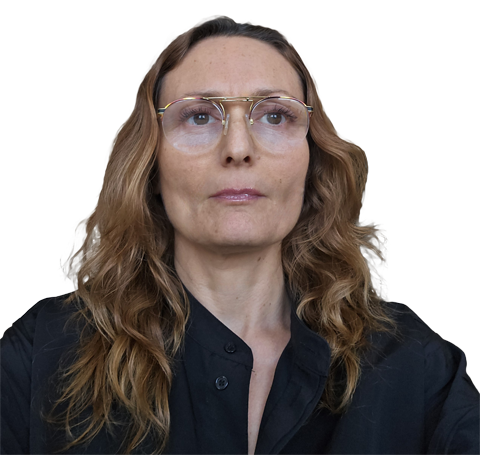
Chiara
Passa
Chiara Passa, a multimedia artist and lecturer, has been exploring digital dimensions through augmented reality (AR) and virtual reality (VR) since 1997. In 2007, she established the diploma course in Multimedia and Technological Arts. Drawing on her academic background in fine arts and audiovisual media, her artistic research forms part of the revival of immersive art that emerged in the mid-1990s and explores the transformative role of technology. Over the years, Passa has developed a personal artistic language centred on immersive technologies. At the start of her career, in the late 1990s, Passa created VR and AR video installations and multimedia works using pioneering techniques such as full-wall projections – CAVE (Cave Automatic Virtual Environment) – and video mapping to produce an immersive effect. These early experiments laid the foundations for her innovative career, but it was only in 2014, with the use of 3D headsets, that she was able to fully immerse herself in the potential of virtual reality. Driven by a profound fascination with space and its transformation through digital languages, Chiara Passa uses VR and AR to challenge the static conception of architecture. Her installations explore the liminal space between the tangible and the virtual, creating a dynamic interpolation in which the boundaries of physical space are expanded, rearranged and transformed. By blending the real environment with an imagined digital space, she invites viewers to experience a sense of suspended reality, a kind of double exposure between the familiar and the unknown.
Her output encompasses a wide range of works, including 3D animations, net art pieces, and interactive, site-specific video sculptures in AR and VR, created using various materials such as Carrara marble, ceramic, plexiglass and 3D-printed components. In addition, Passa creates site-specific video installations using a range of Google Cardboard headsets. In these works, 3D viewers, strategically placed throughout the space, transform ordinary locations into geometric liminal zones, enabling observers to peer into reconstructed virtual realities that highlight the paradox of the contemporary space-time condition, which is increasingly fluid between the real and the digital.
To find out more about Chiara Passa, please see the PDF:
COURSE CONTENT:
The course aims to enable students to produce multimedia artworks using the following technologies: Augmented Reality, Virtual Reality and Mixed Reality. The programme includes the theoretical study of artists (from the pioneers to the present day) who have used these technologies in a creative and innovative way in the field of the arts.
This course is aimed at a wide range of aspiring artists and creatives who wish to use Immersive Reality as a communication tool. The programme aims to equip students with practical and theoretical skills in virtual art, starting with a series of theoretical lectures on artists and the historical context of immersive art. The course continues with a series of practical sessions on professional VR and AR software (Unity, Element 3D), with the aim of creating native VR apps for Oculus Rift or Quest, and AR apps (Android and iOS) for tablets and smartphones. In addition, the course includes the collective creation of a Virtual Reality work for the web using Mozilla Hubs.
The programme includes the learning of 360° photography techniques, photogrammetry, and computer exercises set by the lecturer and completed by the students in line with the scheduled teaching activities.
In the final examination (following a preliminary review), students will be assessed on their AR and VR multimedia works and on the work they have carried out in the multimedia workshop, or independently using their own equipment. Knowledge of the lecture notes provided during the course will also be assessed.
BIBLIOGRAPHY:
Oliver Grau, Virtual Art: From Illusion to Immersion. MIT Press, 2002.
RECOMMENDED READING:
Bruno Di Marino, Nel centro del quadro. Per una teoria dell’arte immersiva dal mito della caverna al VR. Edizioni Aesthetica, 2021.
Simone Arcagni, Immersi nel futuro – La realtà virtuale, nuova frontiera del cinema e della TV. Edizioni University Press, Palermo, 2020.
COURSE CONTENT:
The programme is delivered simultaneously across two stages. The theoretical phase focuses on historical and artistic knowledge and explores in depth the study of animation and video in the multimedia arts, both in their offline form (related to media such as TV, computers and various monitors) and online.
The study of online video focuses on non-linear and interactive storytelling, where animation and video are linked and transmitted via the internet. The course programme covers national and international artists, works and movements from the last two decades and includes theoretical and explanatory lectures, screenings, and the latest research on recent video works and their creators. During the more extensive practical phase, students have the opportunity to use a multimedia workshop equipped for video production, where they can learn to use the software Adobe After Effects. This software is useful for creating, designing and editing digital animations (including 3D animations), videos, special effects, cartoons, music videos, and much more.
In the final examination (following a preliminary review), students will be assessed on their interactive video works, as well as on the work they have carried out in the multimedia laboratory or independently using their own equipment. Knowledge of the lecture notes I provided during the course will also be assessed.
BIBLIOGRAPHY:
Lev Manovich, Il linguaggio dei nuovi media. Edizioni Olivares, 2002.
Software manual: After Effects.
RECOMMENDED READING:
Videoarte in Italia: il video rende felici, G. Saba Cosetta, Valentina Valenti. Edizioni Treccani, 2022.
Andrea Balzola and Anna Maria Monteverdi, Le arti multimediali digitali. Storia, tecniche, linguaggi, etiche ed estetiche del nuovo millennio. Edizioni Garzanti, 2004. Edizioni Garzanti, 2004.
Lev Manovich, After Effects, or Velvet Revolution, 2007 PDF.