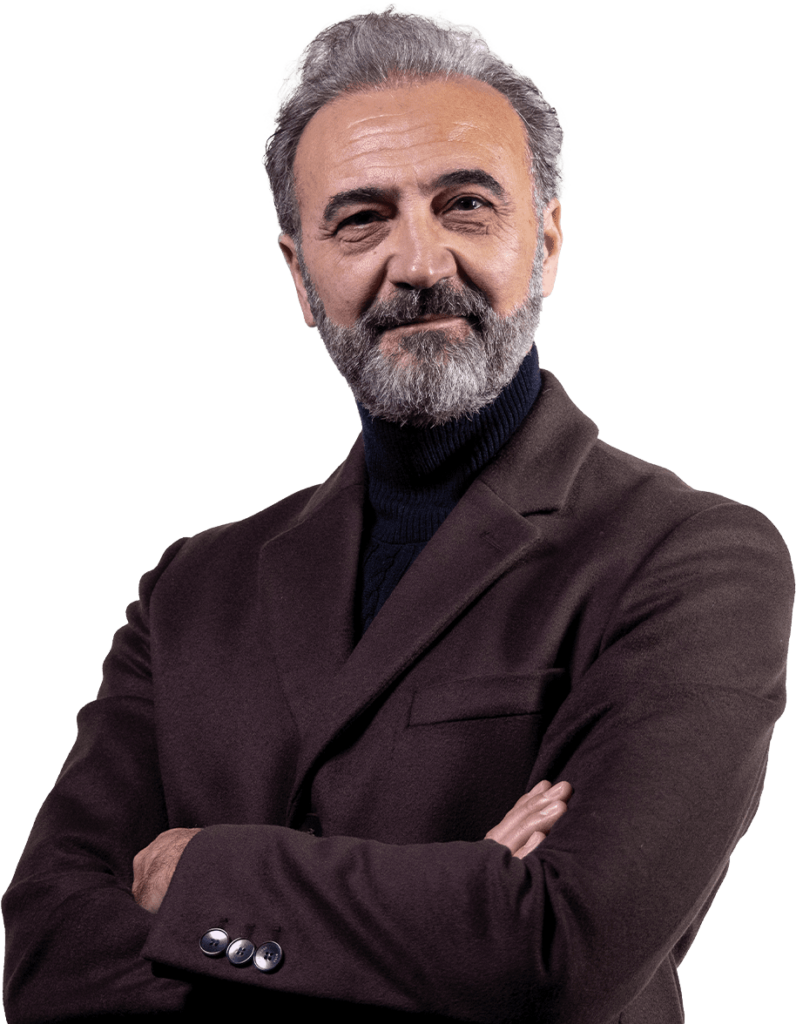
Raffaele
Gavarro
He graduated in Literature from La Sapienza University of Rome (1989) and completed a postgraduate course in Art History and Archaeology at the University of Siena (1995).
He is an art historian, critic and curator.
He has served as artistic director of art fairs in Rome (Artò – Art Fair in Open City, 2009) and Venice (Venice Video Art Fair, 2006–2007), and as well as director of the International Videominuto Festival at the Luigi Pecci Centre for Contemporary Art in Prato (2008–2010).
He has served as Chief Curator at the Isola di San Servolo in Venice (2005–2011), Independent Curator at the Museo Macro in Rome (2006) and Curator of the Maretti Prize (2011–2013).
He curated the Italian Pavilion at the 11th Havana Biennial (2012).
Since the second half of the 1990s, he has curated numerous exhibitions in museums, public spaces and private galleries in Italy and across Europe, and is the author of an equal number of publications on Italian and international artists, as well as theoretical essays on current artistic research, including: Oltre l’estetica, Meltemi Editore, 2007; L’arte senza l’arte – Mutamenti nella realtà analogico-digitale, Maretti Editore, 2020; Avanti&Indietro – 16 conversazioni sull’arte nella realtà e nel tempo analogico-digitali, Maretti Editore, 2021; Il presente e la contemporaneità – L’arte nel time loop analogico-digitale.
He has taught History of Contemporary Art at the Albertina Academy of Fine Arts in Turin.
He lectures on the History and Theory of New Media and on the History of Cinema and Video at the Academy of Fine Arts in Rome.
THREE-YEAR COURSE
Course title:
History of Cinema and History of Video Art
Programme:
The course aims to provide students with a solid basic knowledge of the history of cinema and video art, through a chronological overview of cinematographic and video art works from their origins to the present day. For cinema, an analysis of its relationship with the visual arts will be central. Each student shall submit a written paper, in the form of a short essay, which may focus on a director, a film, an artist, or one or more video works. The essay topic will be agreed with each student individually and will be assessed as part of the examination. The list of films and video works to be covered in the course will be provided by the lecturer during the lectures. Some of the films and video works will be screened, viewed and discussed in class.
Reading list:
Compulsory texts:
G. Rondolino, D. Tomasi, Manuale di Storia del Cinema, UTET Università, 2014
A. Costa, Il cinema e le arti visive, Einaudi, 2022
A. Amaducci, Videoarte. Storia, autori, linguaggi, Kaplan Storia, autori, linguaggi, Kaplan
R. Gavarro, Il presente e la contemporaneità, Maretti Editore
Recommended texts (at least one of the two):
R. Gavarro, L’arte senza l’arte. Mutamenti nella realtà analogico-digitale, Maretti Editore
Denis Brotto, Trame digitali. Cinema e nuove tecnologie, Marsilio Cinema e nuove tecnologie, Marsilio
TWO-YEAR COURSE
Course title:
From the Science Fiction of the Future to the Science Fiction of the Present (Exploring Cinema and Video Art)
Programme:
The course aims, as a preliminary step, to assess students’ basic knowledge of the history of cinema and video, and then to analyse the science fiction ‘genre’, focusing in particular on how it has changed over the decades as a result of scientific discoveries and technological developments. In this context, video art will be analysed primarily in relation to cinema, and therefore in terms of its developments over the past twenty years.
Each student shall produce a written paper, in the form of a short essay, which may focus on a director, a film, an artist, or one or more video works. The essay topic will be agreed with each individual student and will be assessed during the examination.
The list of films and video works to be covered in the course will be provided by the lecturer during the lectures. Some of the films and video works will be screened, viewed and discussed in class.
Reading list:
Compulsory texts:
G. Rondolino, D. Tomasi, Manuale di Storia del Cinema, UTET Università, 2014
A. Amaducci, Videoarte. Storia, autori, linguaggi, Kaplan Storia, autori, linguaggi, Kaplan
V. Sobchack, Spazio e tempo nel cinema di Fantascienza, Bononia University Press
R. Gavarro, Il presente e la contemporaneità, Maretti Editore
Recommended reading (at least one of the three):
A. Costa, Il cinema e le arti visive, Einaudi Editore, 2022
Denis Brotto, Trame digitali. Cinema e nuove tecnologie, Marsilio Cinema e nuove tecnologie, Marsilio
Recommended novels:
F. Herbert, Dune, Fanucci Editore
A. C. Clarke, 2001: A Space Odyssey, Fanucci Editore
P. Dick, Do Androids Dream of Electric Sheep?, Fanucci Editore
THREE-YEAR COURSE
Course title:
Understanding the Analogue–Digital Environment
Programme:
The course aims to provide students on the three-year course with essential knowledge of the history of media, focusing on the theoretical developments that distinguish old media from new media. More specifically, students will be introduced to the study of Digital Humanities, with a primary focus on the specific field of contemporary arts.
Each student will be asked to produce an essay on a topic covered in the course, to be agreed with the lecturer, in which they must demonstrate their ability to analyse the chosen topic scientifically and, equally importantly, to address it using an appropriate theoretical and critical language. The essay will be assessed during the examination.
The course will be structured around lectures, some of which will employ a dialogical approach and encourage discussion. In the classroom, students will also view and analyse examples of works of art, films and television series in which issues relating to the analogue–digital divide are central.
To round off the course, visits will be organised to exhibitions and festivals in Rome that are particularly relevant to the course topics.
Reading list:
Compulsory texts:
1) M. McLuhan, Gli strumenti del comunicare, Il Saggiatore Editore
2) M. Heidegger, The Question Concerning Technology, goWare
3) L. Floridi, La quarta rivoluzione, Raffaello Cortina Editore
4) R. Gavarro, L’arte senza l’arte – Mutamenti nella realtà analogico-digitale, Maretti Editore
5) R. Gavarro, Il presente e la contemporaneità – L’arte nel time loop analogico-digitale, Maretti Editore
One text of the student’s choice from the following list:
1) G. Debord, La società dello spettacolo, Massari Editore
2) L. Manovich, L’estetica dell’intelligenza artificiale. Digital Models and Cultural Analytics, Luca Sossella Editore.
Recommended novels:
P. Dick, Do Androids Dream of Electric Sheep?, Fanucci
W. Gibson, Neuromancer, Mondadori
TWO-YEAR COURSE
Course title:
AI: A New Medium in the Analog–Digital Environment
Programme:
The aim is to structure the course like a genuine research workshop. Students will be divided into small groups and, under the lecturer’s guidance, will work on collecting information and data with the aim of drawing up an overview of the current state of AI. The two focal points of the research will be ethical issues and aesthetic issues.
Reading list:
Compulsory reading:
1) S. Bedessi, Intelligenza artificiale e fenomeni sociali, Maggioli Editore
2) L. Floridi, Etica dell’intelligenza artificiale, Raffaello Cortina Editore
4) R. Gavarro, L’arte senza l’arte – Mutamenti nella realtà analogico-digitale, Maretti Editore
5) R. Gavarro, Il presente e la contemporaneità – L’arte nel time loop analogico-digitale, Maretti Editore
One text of the student’s choice from the following list:
1) G. Debord, La società dello spettacolo, Massari Editore
2) L. Manovich, L’estetica dell’intelligenza artificiale. Digital Models and Cultural Analytics, Luca Sossella Editore.
Recommended novels:
P. Dick, Do Androids Dream of Electric Sheep?, Fanucci Editore
W. Gibson, Neuromancer, Mondadori