Marina
Bindella
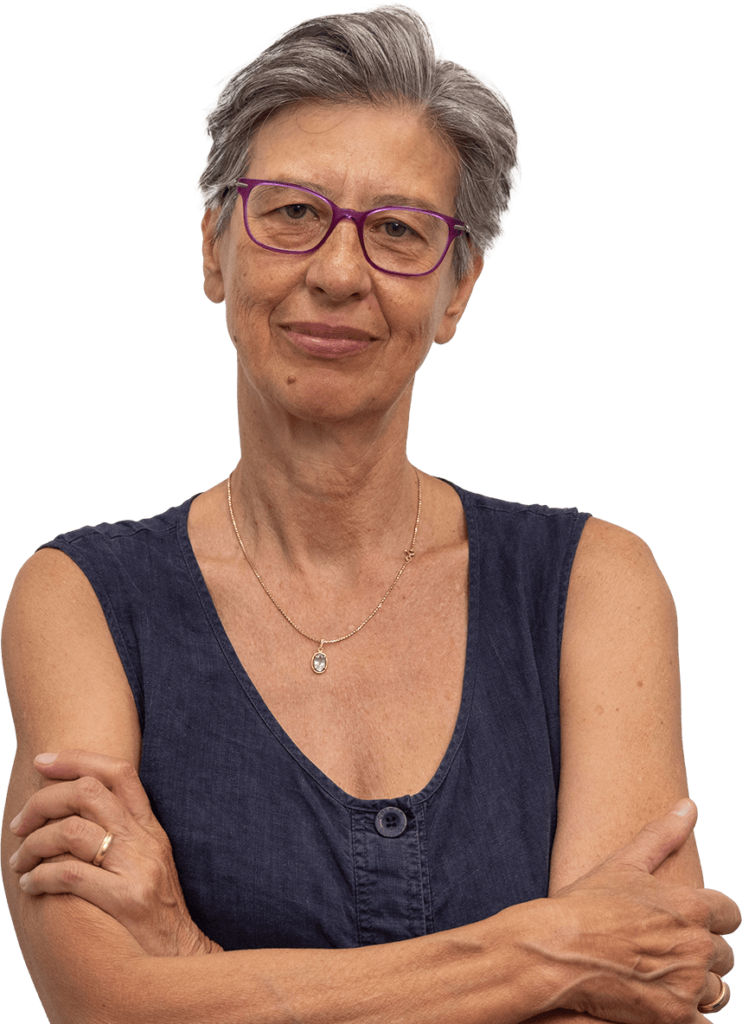
Born in Perugia, she graduated in Art History from the Sapienza University of Rome and obtained a diploma in Engraving from the historic Scuola di S. Giacomo in Rome, where she lives, works and teaches Woodcutting and Artist’s Book Design at the Academy of Fine Arts. At other academies, she has also taught Art History and History of Graphics. The first of her many solo exhibitions was held in 1980: this marked the beginning of her artistic career, which, over the following years, has been expressed through various graphic and pictorial languages. Since 1991, she has published artist’s books with leading private presses and written on various graphic design topics. In 2006, the double solo exhibition Strazza/Bindella-incisioni was held at the Galleria Comunale d’Arte Contemporanea, Ciampino, Rome. In 2013, an installation of her work was inaugurated at the Tor Vergata General Hospital in Rome. In 2015, he held his solo exhibition Finis Terrae at the MLAC (Museum Laboratory of Contemporary Art) at La Sapienza University in Rome.
In 2017, he held a solo exhibition at the Museo di Castelvecchio in Verona and another at the Italian Cultural Institute in Lisbon. In 2018, the Istituto Centrale per la Grafica in Rome hosted a retrospective exhibition of his work, curated by Claudio Zambianchi. He has taken part in the most prestigious international printmaking exhibitions, winning numerous awards. In January 2023, he published
Il Linguaggio dell’Incisione (The Language of Printmaking) through Editoriale Artemide.
The course will provide the essential theoretical and cultural foundation for understanding the relationship between text and image in illustrated books and artists’ books, tracing their historical development from their origins to the latest results of contemporary experimentation, with a particular focus on the history of the artists’ book in Europe, from the first examples in the 19th century to the present day.
The course focuses on the aesthetic choices involved in creating a book as a highly skilled craft and aesthetic object. Paper, text, illustrations, typeface, printing and binding all contribute equally to the creation of the publishing product in its various forms.
Selecting the most suitable images to accompany written text is very important; the techniques
and aesthetic choices must be in harmony with the relevant text and with the chosen type of book or art book.
art book chosen. The design aspect of the book is the fundamental basis, but illustrated books will also be produced
illustrated books will also be produced using mixed media, digitally printed and hand-bound.
Bibliography
Tuzzi, H., Libro antico libro moderno, Carocci, Rome, 2014
Corubolo S., Progettare un libro di poesia e stamparlo con il torchio a mano, Chimerea, Veron, 2004
Il Buon Tempo, exhibition catalogue, Biblioteca Vallicelliana, Rome 2010
Corubolo S., (ed.), Con il torchio, Ampersand, Valeggio sul Mincio (VE), 2014
Gill, E., Saggio sulla tipografia, Ronzani editore, Vicenza 2022
THREE-YEAR COURSE
Students at the Academy of Fine Arts often choose printmaking courses because they feel they are learning a trade, a ‘manual skill’ that is much less intangible than in other disciplines. However, my experience as a teacher suggests that, in general, they tend to view printmaking from a predominantly technical and manual perspective, often disconnected from any reflection on artistic expression or engagement with contemporary artistic languages. A series of theoretical lectures is planned, and the reference texts for the exam will be provided in connection with these lectures.
Therefore, the main objective of this course, to the extent possible within our limited time, is to make students aware that they belong to a cultural context and, at the same time, that they need to seek their own identity as aspiring printmakers/woodcutters. To this end, the initial part of the course will focus on establishing a dialogue between the theoretical study of the various woodcuting languages and practical study through exercises involving the reworking of these languages. This ‘study of marks’ will also cover the use of tools (from knives to gouges, burins and others), materials (end grain and quarter sawn wood, linoleum, PVC and others) and paper; indeed, there will be exercises aimed at exploring the various forms of marks through different engraving and printing techniques (by hand, using a letterpress press and an intaglio press).
Throughout the academic year, students will be required to design and produce woodcut works agreed with the lecturer, which will be monitored through regular assessments and presented at the examination.
Bibliography
Various authors, Il segno inciso nell’arte contemporanea, Editoriale Artemide, Rome 2017
Bindella M., Il linguaggio dell’incisione, Editoriale Artemide, Rome 2023
Mariani G. (ed.), Le tecniche d’incisione a rilievo. Xilografia, Rome 2001
Morley, N., Linocut for Artists & Designers, Ramsbury, Marlborough 2016
Passerini, L., La stampa d’arte. Xilografia, Il Castello, Milan 1991
TWO-YEAR COURSE
The students on this course, not all of whom come from Graphic Art, are part of the two-year Art Illustration and Publishing programme. For this reason, once they have acquired sufficient technical skills, the aim of our work will be to develop a personal woodcutting language that engages with text and the book format. We will examine and discuss the most important illustrators, both historical and contemporary, who have favoured woodcut among their various modes of expression.
We will also explore the fundamental characteristics of typography, the ‘historical sister’ of woodcut since the advent of movable-type printing; indeed, relief printing is a feature of both disciplines. The ultimate goal is to produce a hand-composed typographic book, printed using a letterpress press and illustrated using the woodcut technique.
The publications represent the culmination of the training programme, bringing together all the knowledge acquired and channeling it into the creation of a ‘finished’ product.
Bibliography
Bindella M., Il linguaggio dell’incisione, Editoriale Artemide, Rome 2023
Morley, N., Linocut for Artists & Designers, Ramsbury, Marlborough, 2016
Passerini, L., La stampa d’arte. Xilografia, Il Castello, Milan 1991
Corubolo S., (ed.), Con il torchio, Ampersand, Valeggio sul Mincio (VE), 2014
Il Buon Tempo, exhibition catalogue, Biblioteca Vallicelliana, Rome 2010