Maria Cristina
Reggio
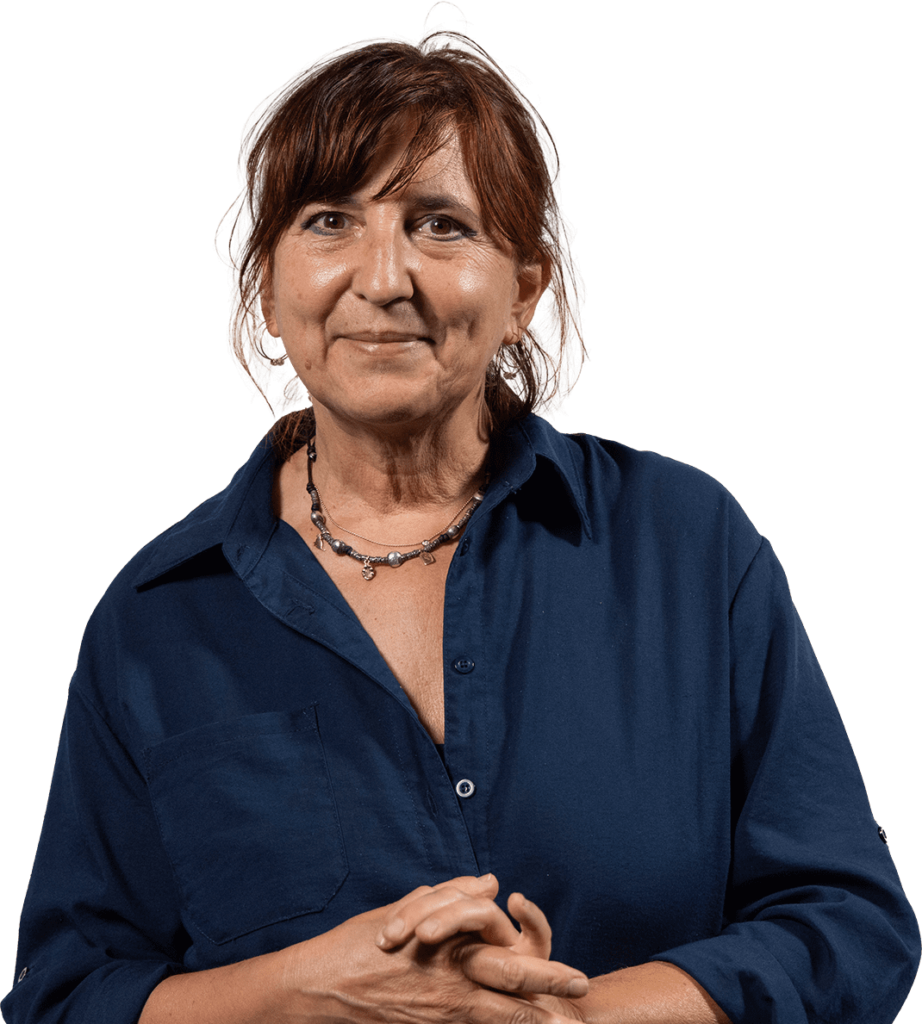
With a background in set design, Maria Cristina Reggio has previously worked on various theatre and film productions; since the 1990s, she has devoted herself to the study of the body in performance and multimedia practices, combining theoretical and teaching work with artistic research. She writes about the performing arts for various print and online magazines and has set up and manages several blogs. She has taken part in various international conferences and delivered seminars in Italy and abroad.
PROGRAMME FOR THE FIRST YEAR OF THE 2025–26 ACADEMIC YEAR
TEAM CODE THREE-YEAR PROGRAMME 1st year: ucryrtw
Second semester – Mondays, 2.00 pm – 7.00 pm, Room 301, Via Ripetta
THEORETICAL LECTURES
The general focus of study is the living body, in action, in motion, and in relation to others and the environment.
Starting with an exploration of the principles of representing the human body, the focus shifts to each individual’s own body: each student will study their own body, seeking to identify the skeletal and joint structure that determines their personal kinetic code. Each artistic anatomy lecture is published online on the CON IL CORPO VIVO website, where references to the work of numerous artists on and with the body can be found.
WORKSHOP
Each student draws an anatomical map of their own body, divided into different segments. The process begins with observing oneself in the mirror and drawing one’s body in action within space. Each student works with their own body, both in motion and at rest, choosing their own actions and drawing their movements using a mirror, photography, non-professional video and drawing. Over the course of the semester, each student is required to produce a final project agreed upon with the lecturer.
READING LIST
Anatomy textbook of your choice
Study of lessons delivered and published on the blog CON IL CORPO VIVO.
Readings selected from the following texts:
Angelo e Giovanni Morelli, Anatomia per gli artisti, Fratelli Lega ed.
H.Foster, R.Krauss, Y.A.Bois, B. H.D. Buchloh, Arte dal 1900, Zanichelli
PROGRAMME FOR THE 2nd AND 3rd YEARS OF THE 2025–26 ACADEMIC YEAR
TEAM CODE THREE-YEAR PROGRAMME: 2nd and 3rd years d8fkm0r
Second semester – Friday, 2.00 pm – 7.00 pm, Room 301, Via Ripetta
THEORETICAL LECTURES
The general focus of study is one’s own living body, in action, in motion, and in relation to others and the environment. Each year, the focus is placed on different apparatuses and/or systems – not only the musculoskeletal system – and the programme for the second and third years varies to allow students completing all three years to follow a different programme each year.
Each new artistic anatomy lecture is published online on the CON IL CORPO VIVO website, where references to the work of numerous artists on and with the body can be found.
R-ESISTENZE
Following on from last year’s programme on DIS-EQUILIBRI, this year we will explore other forces that act on the body, determining its resilience in a wide range of situations: when walking, running, exerting oneself, or experiencing a traumatic event. The body exists because its cells, tissues and organs endure and reproduce.
WORKSHOP
The aim of the course is for students to conceive and produce a work based on the observation and study of the body, focusing on the apparatus or system explored in depth during the theoretical lectures. Students work using drawing, physical actions, a digital microscope, photography and non-professional video.
READING LIST
Anatomy textbook of yours choice
Study of lessons delivered and published on the blog CON IL CORPO VIVO.
Readings selected from the following texts:
Francesco Careri Wallscapes, Camminare come pratica estetica, Einaudi, 2006
Thomas Bernhard, Camminare , Adelphi, 2018
Rebecca Solnit, Storia del camminare, Ponte alle grazie, 2018
Bessel Van Der Kolk Il corpo accusa il colpo Raffaello Cortina ed.
H.Foster, R.Krauss, Y.A.Bois, B. H.D. Buchloh, Arte dal 1900, Zanichelli
FINAL EXAMS FOR THE THREE-YEAR COURSE (1st, 2nd and 3rd years)
1) A workbook completed during lessons, which can be produced using any technique of your choice.
2) A written report (a template for which will be provided at the start of the course) on a work by an artist who has worked with the body, chosen from among those mentioned during the theory sessions.
2) Final project using an agreed technique, based on the body in motion (preparatory drawings, techniques of your choice).
TWO-YEAR PROGRAMME 2025-26
Second term – Thursday at 2.00 pm – 7.00 pm, Room 301, Via Ripetta
TWO-YEAR PROGRAMME TEAM CODE: 1vip2pk
THEORETICAL LECTURES
The general focus of study is one’s own living body, in action, in motion, and in relation to others and the environment.
Content of theory lessons 25–26:
WHITE, THE VIBRANT COLOUR OF THE NUDE
What colour is the skin of the nude body in art? The act of drawing a body on a blank sheet of paper is always an abstraction of reality, yet this reality also makes a comeback, permeating contemporary art. Can we therefore compare the living body with the vibrant white of a statue, a painting or a performance artist?
Consider Man Ray, Mapplethorpe, Stelarc and Bifo, but also Penone, Giulio Paolini, Velázquez, Michelangelo, the hundreds of statues that fill museums, and the complexions of 17th-century paintings.
Each new artistic anatomy lecture is published online on the CON IL CORPO VIVO website, where references to the work of numerous artists on and with the body can be found.
WORKSHOP
Building on the individual research that each student undertakes during their two-year course, students are invited to conceive a project focusing on the topics covered in the lectures and in keeping with their own expressive technique. Students use drawing, photography, video and a digital microscope. The course includes a number of visits to museums in the capital.
FINAL EXA,M
The documentation of the various stages of the agreed project is assessed, with particular attention paid to its presentation: a personal portfolio containing drawings and non-professional photographs and videos.
READING LIST
Giorgio Agamben, Nudità, Nottetempo
Kenneth Clark, Il nudo, Neri Pozza
Letture scelte da
H.Foster, R.Krauss, Y.A.Bois, B. H.D. Buchloh, Arte dal 1900, Zanichelli
Studio delle lezioni svolte e pubblicate nel blog CON IL CORPO VIVO.
Michel Pastoureau Bianco. Storia di un Colore
PROGRAMME 2025-26
TEAM CODE: v7agk2k
First semester – 45 hours
Room 1A
COURSE DESCRIPTION AND OBJECTIVES
Theory lectures:
The main aim of the theory classes is to encourage reflection on the ways in which art operates independently of and diverges from the strategies used by the media to disseminate or censor various political and social issues, and to enable each student to develop their own unique project over the course of the year, in collaboration with other modules.
The theoretical lectures on Multimedia Communication analyse the work of a number of contemporary artists who, operating in different disciplinary fields, explore and critically reappraise the constituent elements of various forms of multimedia communication: codes, strategies and information channels.
In addition, students are provided with the theoretical tools to enable them to present their portfolio and multimedia projects.
ACTIVITIES
In addition to the theoretical lectures, the topics of which are listed in detail below, the course includes practical exercises that critically analyse and reinterpret the channels, messages, codes and noise of multimedia communication.
All lecture materials are published and kept up to date on Teams and on the lecturer’s blog, where, for each topic covered, you will find a page with various links and bibliographical references.
http://comunicazionemultimedialeaccademia.blogspot.it/
LECTURE TOPICS
1. Against communication: Perniola’s theory — the early works of the pioneers: Andy Warhol, Grimonprez, Nam June Paik
2. Operations with new media: art strategies that REORIENT communication — hijacking, subversion, intrusion of error
3. The work on data by Paolo Cirio and by Eva and Franco Mattes – Anna Scalfi
4. Behind the interface, information becomes aesthetic: Ryoji Ikeda and the sublime nature of binary code
5. The infinite persistence of images in new media, a present that anticipates the future in AI. Donatella Della Ratta
6. Hyperobjects according to Timothy Morton, The Cloud by Arkadi Zaides
7. Political and social issues in the work of Antoni Muntadas, Rimini Protokoll, Blast Theory, Agrupación Señor Serrano.
8. Farocki and the communication of war, Thinking with the Eyes, Paul Virilio, Cinema and War
9. Natalie Bookchin and the intrusion of video game culture, the philosophy of gaming, texts by Geert Lovink.
10. Communication, art and artificial intelligence: the infinite atlases of AI art. (books by Ben Vickers, Kate Crawford, Chiara Canali)
FINAL EXAM
• Oral presentation on a single book/essay chosen from the reading list
• Presentation of the student’s portfolio
• Presentation of a multimedia project: from development on a platform such as Miro to a final presentation that includes text, images, video and drawings to facilitate a clear understanding of the project.
READING LIST
Geert Lovink, Nichilismo digitale, 2019
Geert Lovink, Ossessioni Collettive,
Harun Farocki. Pensare con gli occhi, 2017
Mario Perniola, Contro la comunicazione, Milan, 2004,
Modesta di Paola, L’arte che traduce. La traduzione visuale nell’opera Antoni Muntadas
Tommaso Ariemma, Filosofia del Gaming, Tlon, 2023
Lev Manovich, Il linguaggio dei nuovi media, 2011 (selection of chapters)
Chiara Canali, Tecnosocialità, Postmedia, 2019
BOLTER, GRUSIN, Remediation. Competizione e integrazione tra media vecchi e nuovi, 2003
Ben Vickers, K Allado Mc Dowell, Atlas Of Anomalous AI, 2020 (English)
Kate Crawford, The Atlas of AI _ Power, Politics, and the Planetary Costs (English)
Simone Santilli, My favourite Game, 2023
Matteo Bittanti, Machinima, dal videogioco alla videoart, 2017
Matteo Bittanti, Game over, 2020
THREE-YEAR PROGRAMME 2024-25
TEAM CODE:
Second semester – Mondays, 1.30 pm – 7.30 pm
TOPIC OF THEORETICAL LECTURES
HOW DO I TRANSFORM MYSELF?
The body is constantly transforming, from its origin as a single cell through to old age.
By focusing on the body’s transformations from its conception as a single cell and also using a digital microscope in the classroom, we study the human body in its continuous transformation, while at the same time drawing on the practice of autofiction in the visual arts.
WORKSHOP
Building on the individual research that each student undertakes during their two-year course, students are invited, through exercises, to engage with the topics discussed in the lectures and to conceive a personal work using tools and techniques of their choice.
FINAL EXAM
The documentation of the various stages of the agreed final project is assessed, with particular attention paid to its presentation: a personal portfolio containing drawings and non-professional photographs and videos.
READING LIST
CON IL CORPO VIVO.
Daniel E. Lieberman, La storia del corpo umano, Le Scienze
J.L. Nancy, Il ritratto e il suo sguardo, Cortina ed
Sergio Blanco, Autofinzione. L’ingegneria dell’Io, Cue press
Orians, Purvers, Hills, Biologia, Il Corpo Umano, Zanichelli;
John Zachary Young, La scienza dell’uomo-Biologia, evoluzione e cultura, Bollati Boringhieri