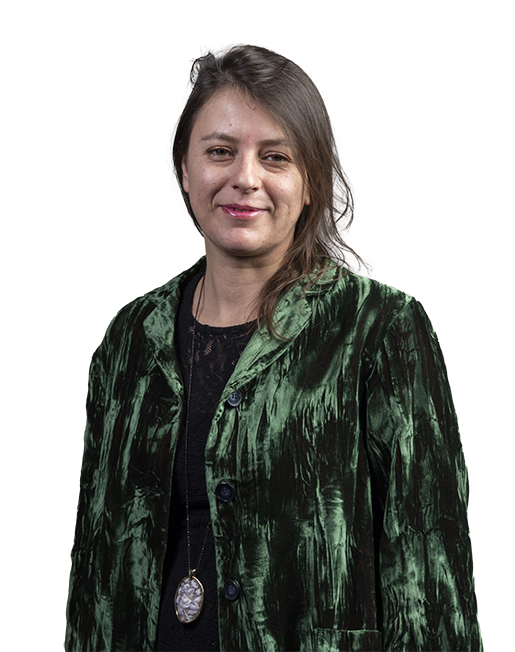
Manuela
Pacella
Art historian and critic.She obtained a four-year degree (under the old system) in Art History from La Sapienza University in Rome, with a monographic thesis on David Tremlett, and qualified as an art historian at the School of Specialisation in Art History at the University of Siena, under the supervision of Enrico Crispolti, with a thesis on the history of photography and the relationship between art and early photography.
After a decade working for ministerial institutions such as the National Gallery of Modern and Contemporary Art, the Central Institute for Graphics and the Central Institute for Catalogues and Documentation, she has focused more on her work as an independent curator and art critic.
In her curatorial work, she focuses on cultural exchanges between Italy and certain Central and Northern European countries. She is particularly well versed in the art scene in Northern Ireland, where she has been working since 2011 and where, in 2013, she took part in the ICI (Independent Curators International, New York) intensive curatorial course held at the CCA in Derry and in the international residency at Flax Art Studios in Belfast. As guest curator at the MAC in Belfast, she curated the exhibition Lost in Narration. Riccardo Giacconi, Invernomuto and Luca Trevisani and coordinated the second Curatorial Directions event, which focused on the importance of text and narrative within the curatorial process, with workshops and seminars held in Belfast and Milan.
In 2015 and 2016, she was a researcher and editorial coordinator for NERO (Rome).
In addition to exhibition catalogues, she regularly writes for ‘Flash Art’ (Italy and International), ‘The Visual Artists’ News Sheet’ (Dublin) and ‘NERO Editions’ (Rome); her essay on Bertille Bak, La fiaba del reale, was published (in Italian and English) in 2018 by Postmedia books, Milan.
She currently teaches at IED (Rome campus), the Academy of Fine Arts in Rome, the American University of Rome and NABA (Rome campus), and is the creator and editor of the online column Tell me stories! for ‘Flash Art’ and of the writing platform ruth.onl.
The aim of the course is to make students aware of the diversity of editorial roles within an editorial team, through theoretical lectures, possible external visits (if student numbers allow) and the production of a final editorial product based on the students’ specific interests and areas of focus.
After a brief overview of the history of the book and the printing press, we will move on to analyse the fascinating yet highly competitive world of publishing, using case studies and examples of independent publishing in Italy (particularly magazines).
The various key figures within an editorial team will be examined, exploring their roles and functions in depth and, together with the students, identifying which role best suits their skills and interests: from author to translator, from publisher to managing editor, from editor to proofreader, from art director to graphic designer, and from press officer to media manager.
Guest speakers will be invited to share their experiences on key issues in the publishing world, and various art publishing products – magazines, catalogues, series, collections of essays, and artist’s books – will be examined, with examples provided in class.
If possible – depending on the time available and the number of students – the module will conclude with an examination of a hypothetical publishing product requested by an equally hypothetical client, and the class will be divided into groups to develop publishing proposals. A practical demonstration of how the publisher is essentially a curator who, through study, research and collaboration, seeks to ‘shape’ the needs of both authors and end users, i.e., readers.
Attendance and active participation in lectures are required; during these lectures, the lecturer may add articles or texts to the compulsory reading list. A good knowledge of the English language and the history of contemporary art is also strongly recommended.
Examination
The exam is oral. Questions will be asked on the course content and the compulsory reading list.
If it is possible to undertake a group practical exercise during the course (with a minimum of 3 and a maximum of 5 students per group), the exam will begin with a joint explanation of the exercise and then continue with questions to each student in the group.
Non-attending students:
Non-attending students are kindly requested to contact the lecturer in good time to agree on the programme. For the exam, in addition to studying the compulsory texts, students are required to study one book of their choice from the recommended reading list.
Compulsory texts
- Lecture handouts and notes.
- Calasso, Roberto. L’impronta dell’editore. Adelphi Edizioni, Milan 2013.
- Cicala, Roberto. I meccanismi dell’editoria. Il mondo dei libri dall’autore al lettoreMcLuhan, Marshall. The Medium Is the Massage. Corraini Edizioni, Mantua 2020 [2011]. We recommend the English version published in the Penguin Classics series, London 2008 [1967].
- Marcadent, Saul. Editoria come curatela (Publishing as Curatorship). Marsilio Editori, Venice 2020.
Recommended reading (one text of the student’s choice is compulsory for those not attending lectures)
- Calasso, Roberto. Cento lettere a uno sconosciuto (One Hundred Letters to a Stranger). Adelphi Edizioni, Milan 2003.
- Mistretta, Enrico. L’editoria. Un’industria dell’artigianato. Il Mulino, Bologna, 2006.
- Moretti, Dario. Il lavoro editoriale (Publishing Work). Laterza, Rome–Bari 2005.
- Sabatini, Gabriele (ed.). Angelo Fortunato Formiggìni. Lezioni di editoria. Italo Svevo Edizioni, Rome 2022.