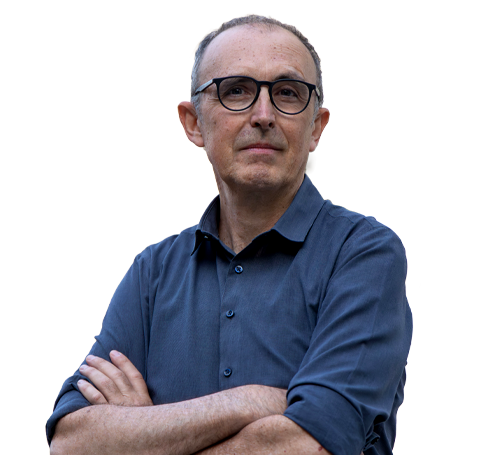
Luca
Valerio
Since 1999, he has been involved in experimentation with video language.
After graduating in Economics and then obtaining a diploma from the Academy of Fine Arts, he specialised in education (postgraduate course in Audiovisual Methodology and Education).
He focuses on the new languages of art, particularly new technologies and digital video, and supervises students in the production and creation of video works.
Invited to the 12th Rome National Quadriennale at the Palazzo delle Esposizioni in 1996, he has exhibited his work in solo and group exhibitions in Italy and abroad. In 2019, he took part in the MACRO Asilo programme with the project HomeSweetHome.
As part of the artistic and cultural activities of the Academy of Fine Arts in Rome, he has curated video festivals and workshops on Audiovisual Languages and Techniques, and produced documentaries, art videos and commercial videos.
He is currently Coordinator of the Department of Design and Applied Arts and Head of Spaces and Equipment at the Campo Boario campus.
The objective of the course is to analyse audiovisual languages and filming techniques, and to apply them in order to create a multimedia product.
The course is divided into two sections: the first is theoretical, focusing on audiovisual language, and the second is practical, covering the actual creation of an audiovisual product. Starting with an analysis of audiovisual language and how the mechanisms of communication have changed with the use of video images, students will explore the fundamental techniques of video filming. The aim is to provide students with the methodological and technical tools needed to navigate the various stages of creating a digital multimedia product.
Topics covered in the theory lectures (delivered using multimedia presentations and examples of film and video works):
- Origins and history of the audiovisual medium: from its inception to the codification of a language
- Cinema: the synthesis of the arts
- Video: from early experiments to the digital age
- Sculpting time
- Another space
- The body in motion
- Sound
- Digital and Analogue: Defining New Technological Standards
- Video as an autonomous form of artistic expression
Throughout the course, students will be recommended films to watch during the week, which will then be discussed in the following lecture. At the same time, recommended readings from the literature will be provided to help students explore the topics covered in greater depth.
As part of the practical work, at the start of each academic year, a theme to be explored will be determined, and, by analysing how artists have approached this theme, students will be provided with the technical tools and food for thought needed to experiment with the theoretical concepts in a practical way.
Students will agree a multimedia project with the course lecturer, which will be reviewed on a regular basis. The resulting work will be assessed during the examination.
To pass the course, students must demonstrate a thorough knowledge of the textbook and the handouts provided by the lecturer over the course of the year. At the end of the lectures, students will take a multiple-choice test to assess their theoretical knowledge. Having passed the test, students will be admitted to the final assessment, which consists of an evaluation of their technical skills and a presentation of the required video project.
The final assessment will take into account the result of the test and the assessment of the video projects submitted:
- Themed video – max. 5’
- Themed video – max. 5’
- Open-theme video – max. 5’
- Classic cinema video – max. 5’
- Videos produced during the course – 30”
During the exam, the projects presented and the films recommended in class will be discussed.
Recommended reading list:
Gianni Rondolino, Dario Tomasi, Manuale del film, Utet Università, Novara, De Agostini, 2011;
Further reading:
Burch Noël, Prassi del cinema, Il Castoro, 2000.
Further reading on specific topics will be identified during the course.
The course aims to provide students with the methodological and technical tools required to produce a video edit.
The course programme is divided into two sections: the first is theoretical, covering the history and aesthetics of editing; the second is practical, where, after outlining certain methodological aspects of the use of digital technology in the visual arts, the entire video post-production process is addressed, from the acquisition phase through to export, in order to produce an actual edited video. At the end of the course, students should be able to produce a video edit and understand the basic principles of audiovisual production.
Lecture topics (delivered through multimedia presentations and examples of film and video works):
- History of editing:
Linear and non-linear editing, the origins of editing, digital and analogue, the establishment of new technological standards, silent and sound film, modern cinema and experimental cinema, editing styles, electronic art in the age of mechanical reproduction – video art from the earliest experiments to the digital era. - Editing aesthetics:
The language of cinema, découpage and collage, narrative, discursive and cross-cutting editing, tools, invisible editing, alternating and parallel editing, cinematic time, images and sounds, editing and graphics. - Video Editing Techniques:
Analogue and digital video; capture, compression and formats; editing techniques; continuity editing; effects and transitions; titles; audio post-production; rendering and export.
Main software used: FinalCut, Adobe Premiere.
An integral part of the course is the viewing of films on the Academy’s premises and in cinemas.
As part of the practical work, at the start of each academic year, a theme to be explored will be determined. By analysing how artists have approached this theme, students will be provided with the technical tools and food for thought needed to put the theoretical concepts into practice.
Students shall agree a multimedia project with the course lecturer, which will be reviewed on a regular basis. The final product will be assessed during the examination.
Under the supervision of the lecturer, students are required to produce a video edit using the techniques demonstrated. For study paths that carry 6 credits, one fewer video project is required.
To pass the course, students must demonstrate a thorough knowledge of the textbook and the handouts provided by the lecturer throughout the year. At the end of the lectures, students will take a multiple-choice test to assess their theoretical knowledge. After passing the test, students will be admitted to the final examination, which consists of an assessment of their technical skills and a presentation of the required video project.
The final assessment will take into account the result of the test, the work produced during the year, and the video projects submitted at the end of the course.
During the exam, students will discuss their final video projects and the films recommended in class.
- 1 classic cinema video, short film, maximum duration 5 minutes
- 1 video project on a free theme, maximum duration 5 minutes
- 1 video project to be produced during the semester on a topic defined in class, maximum duration 5 minutes
- 1 video project on the theme of Documentire
- 1 audiovisual documentary produced in the video production workshop under the supervision of Valerio Sammartino (for Photography and Video students)
It is necessary to revise the two video projects, Fictions and Documentire. There will be no reviews for the open-theme video.
Recommended reading list:
Diego Cassani, Manuale del montaggio, Milan, Utet Universitaria, 2000;
Further reading:
G. Millar, K. Reisz, La tecnica del montaggio cinematografico, Turin, Lindau ed.,, 2001;
Vincent Amiel, Estetica del montaggio, Turin, Lindau ed., 2006.
In-depth texts on specific topics will be identified during the course.
The course aims to provide students in the third year of the three-year Photography and Video programme with the methodological and technical tools required to design and produce a video installation.
After outlining the methodological challenges of setting up a video work in an environment, the course addresses the entire process of designing, producing and installing a multimedia work in a space.
Lecture topics (delivered through multimedia presentations and examples of video works):
- From video art to video installation
- Site-specific work
- Multi-channel video
- Projection tools
- Criteria for selecting and positioning a video projector in a space
- Synchronisation systems
At the end of the course, students should be able to produce a video edit for the purpose of creating a video installation. An integral part of the course is the installation and communication workshop led by Giuseppe Di Giovanni, which focuses on the design of a digital space.
Main software used: Adobe Premiere, SketchUp, Dataton WatchOut, InDesign.
Students will agree a multimedia project with the course lecturer, which will be reviewed periodically. The final product will be assessed during the examination. The final assessment will take into account the work produced during the year and the video projects submitted at the end of the course.
The following video projects will be discussed during the examination:
- 1 video installation project on a free-choice theme, maximum duration 5 minutes
- 1 video installation project on a defined theme, to be developed during the semester and submitted for review
- 1 multi-channel video installation project to be developed during the semester and submitted for review
Each project must be accompanied by the design, a simulation and a technical data sheet.