Eclario
Barone
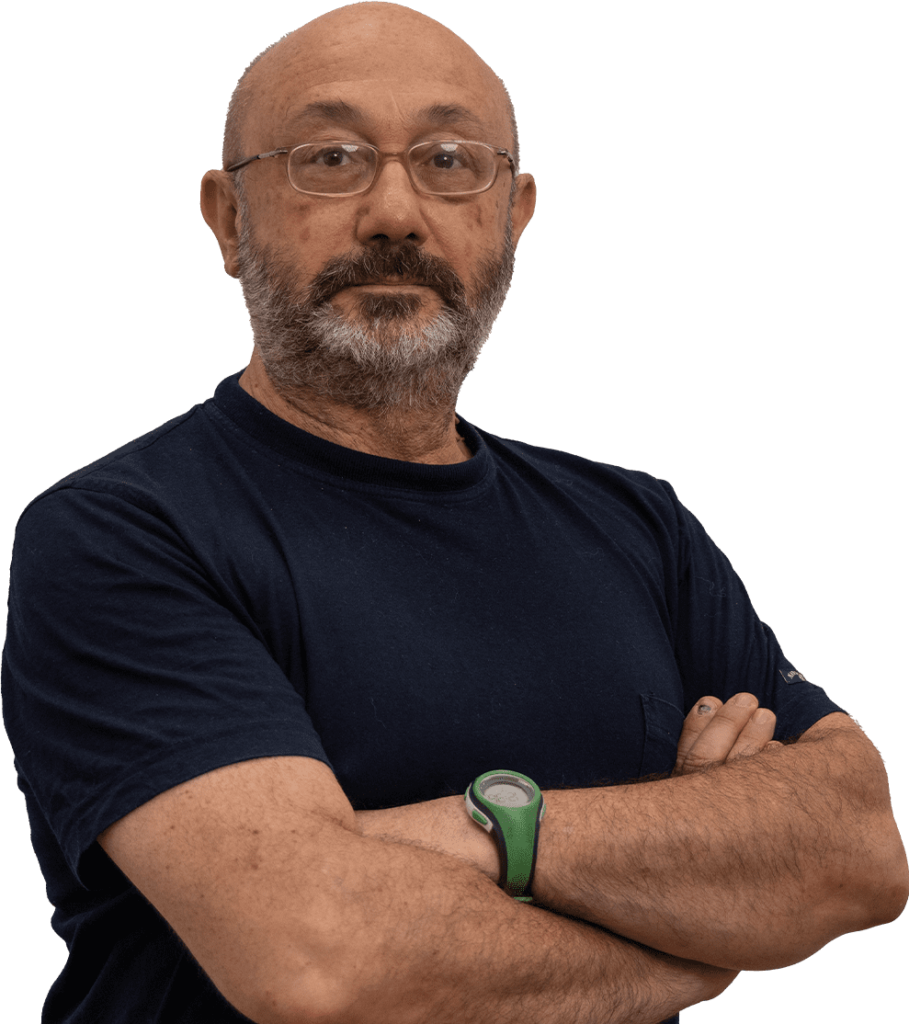
Born in Salerno on 23 January 1961.
From 1980 to 1984, he studied under the artists Nato Frascà and Gianpaolo Berto at the Academy of Fine Arts in Rome.
Lecturer in Painting and Drawing at the Academy of Fine Arts in Rome; from 2016 to 2017, he was Lecturer in Drawing at the Academy of Fine Arts in Florence; from 2010 to 2016, he was Lecturer in Painting at the ‘Mario Sironi’ Academy of Fine Arts in Sassari; and in 1992, he was Lecturer in Sculpture at the Academy of Fine Arts in Frosinone.
In the 1987–1988 and 1988–1989 academic years, he held an Erasmus scholarship for a doctorate in Sculpture at the Universidad de La Laguna in Tenerife, Spain.
In 1989, he was invited to the First Mediterranean Printmaking Biennial – Agios Nikolaos – Gulf of Mirabello – Crete – Greece.
He has held various solo and group exhibitions of painting, sculpture, printmaking, illustration and installations, both in Italy and abroad. He has worked in the fields of theatrical set design, television and cinematography. He works with sculpture in various materials, installations, painting, printmaking and visual poetry, with a particular interest in the relationship between visual art and contemporary music. He has undertaken in-depth study of the instinctive and informal visual signature, based on Nato Frascà’s ‘Teoria dello Scarabocchio degli adulti’ (Theory of Adult Doodling).
Published texts:
– Nato Frascà. Education: An Artistic Journey. VADO>VERSO>DOVE>VENGO 2.0, Eclario Barone and Franca D’Angelo 2019, Academy of Fine Arts in Rome. Publisher: ‘L’Erma di Bretchneider’. Rome.
– ‘Alcuni topoi della Psiconologia, una proposta di glossari’ (‘Some Topoi of Psychology: A Proposed Glossary’), in ‘Parol’, No. 24, Quaderni d’arte ed epistemologia, various authors, 2014, Academy of Fine Arts in Sassari, Edizioni EDES, Sassari
LEARNING OBJECTIVES:
The aim of the course is to develop, through a variety of practical exercises and ongoing individual and collective reflection, an original and conscious use of the line, enabling students both to translate and communicate their visual explorations and to organise and structure more complex works (paintings, sculptures, performances, etc.).
CONTENT AND TOPICS:
Experimentation with various drawing techniques: slow and fast execution time; rhythm of the mark; energy of the mark; drawing from life and from the imagination; negative and positive; drawing as a project and as free expression; composition; use of compositional grids and geometry; synthetic and analytical drawing; chiaroscuro; use of form and texture; portraiture; the static and moving body; symbolic meanings of the mark. Use of traditional and mixed media techniques. Practical application and interpretation of the ‘Adult Doodle’ according to Nato Frascà’s psychonological theory.
References to the drawing methods of contemporary and historical artists (monographic presentations)
TEACHING METHODS / COURSE STRUCTURE:
The course comprises theoretical and practical sessions, including the use of live models.
Both traditional and experimental techniques will be used. The use of sketchbooks will be a key component:
1- hands, feet, eyes, ears, mouth; 2- figures in everyday poses; 3- views and places; 4- exploration of themes from the book ‘Letters to a Young Poet’ by R. M. Rilke; 5- individual study of the painting ‘Vision after the Sermon’ by Paul Gauguin, to be compared with and reworked alongside another work of the student’s choice.
– THE ZEN REAM: study of one’s own handwriting, through daily practice, on a ream of 500 A4 sheets.
FINAL ASSESSMENT METHOD:
The final exam will be preceded by at least two assessments (in person and online) over the course of the year, during which the sketchbooks and folders (and/or PDF files) containing all the work produced will be reviewed. The assessment criteria for the exam will be: attendance, individual development of the proposed topics, and the presentation and quality of the work shown.
THEME OF THE YEAR: ‘The Vision after the Sermon’ by Paul Gauguin.
EXPERIENCES:
– Visits to exhibitions and museums, both ‘in person’ and ‘remotely’, with the production of graphic studies using various techniques
– Practising and decoding the ‘Scarabocchio’ (sketchbook) according to Nato Frascà’s ‘Psiconologia’.
– Where possible, visits will be organised to museums, exhibitions, parks, botanical gardens, etc.
PERSONAL EQUIPMENT:
– Sketchpad, e.g. Fabriano F4, with smooth and textured pages
– Pencils, graphite pencils, pens, nibs, felt-tip pens, brushes, soft rubber, palette knife, etc.
– Stanley knife, scissors, ruler, masking tape,
– Glue stick
– Apron (optional)
– Synthetic sponge, natural sponge
– 50 × 70 cm folder
– ream of A4 photocopy paper (at home)
BIBLIOGRAPHY:
– R. M. Rilke, Letters to a Young Poet
– John Berger, Ways of Seeing, Il Saggiatore
– Wassily Kandinsky, Point, Line, Plane, Adelphi
– Paul Klee, Theory of Form and Figuration, Mimesis
– Betty Edwards, Drawing on the Right Side of the Brain, Longanesi & C.
– Nato Frascà, L’Arte all’ombra di un’altra luce: Lo Scarabocchio degli adulti (la Psiconologia), Editore Franca D’Angelo Frascà
The course consists of a theoretical part and a practical part:
THEME OF THE YEAR:
‘WAR AND PEACE’ The dream of reason gives birth to… art!
THE THEORETICAL COMPONENT:
Using the recommended texts, analysis of the work of artists from various periods (copying, analysis of parts and signs, symbolism, etc.) who expressed themselves primarily through graphic form. Reading of the book FIGURE: Come funzionano le immagini dal Rinascimento a Instagram by Riccardo Falcinelli, EINAUDI Stile libero EXTRA.
Presentations and practical exercises in interpreting the work.
PRACTICAL COMPONENT:
– Study of the human body using a live model or original videos – Exercises on various topics related to the study of visual signature, composition, texture, drawing techniques, illustration, etc.
Examples of exercises:
– Designing your own Monogram – Your own abstract portrait – Precise and Imprecise lines – Drawing a Negative Space – Drawing a Positive Space – Drawing a Diagonal Path – Life drawing: The posing model – Natural textures, etc.
– Study of nature from life and subsequent reworking of forms – Drawing exercises through daily ‘sketchbook’ practice
SKETCHBOOKS:
– Life-drawing figures – noses, hands, feet, ears – Daprès from works by engravers of the student’s choice, with analysis of the lines.
– Textures: natural, abstract, etc.
ANALYSIS OF AN ARTWORK:
– Guttuso’s ‘Crucifixion’, to be combined with and developed alongside another work of the student’s choice.
– Goya’s ‘The Disasters of War’ series.
Copying, analysis of parts and lines, composition, decomposition, reworking, symbolism, etc.
THE ‘ZEN REAM’:
Study of one’s own handwriting through daily practice on a ream of 500 A4 sheets.
– Visits to exhibitions and museums, including ‘remote’ visits, with the production of graphic studies using various techniques.
– Practising and decoding the ‘Scribble’ according to Nato Frascà’s ‘Psiconologia’.
THE EXAM:
At least two review sessions (in-person and online) are scheduled prior to the examination.
The assessment criteria for the exam will be: attendance, individual development of the proposed topics, and the presentation and quality of the work submitted.
PERSONAL RESOURCES:
– Various authors, Le notti chiare erano tutte un’alba. An anthology of Italian poets in the First World War. Bompiani.
– Michael Walzer, On War, Edizioni Laterza.
– Sun Tzu, The Art of War.
– Riccardo Falcinelli, FIGURE – Come funzionano le immagini dal Rinascimento a Instagram, EINAUDI Stile libero EXTRA.
– William Kentridge, SIX DRAWING LESSONS, Johan e Levi editore.
– Betty Edwards, Drawing on the Right Side of the Brain, Longanesi editore.
– Nato Frascà, L’Arte all’ombra di un’altra luce: Lo Scarabocchio degli adulti (la Psiconologia), Ed. Franca D’Angelo and Xuan Frascà.
LEARNING OBJECTIVES:
The aim of the course is to develop, through a variety of practical exercises and ongoing individual and collective reflection, an original and conscious use of the line, enabling students both to translate and communicate their visual explorations and to organise and structure more complex pictorial works.
CONTENT AND TOPICS:
Exploration of various drawing techniques: slow and fast execution times; rhythm of the line; energy of the line; drawing from life and from imagination; negative and positive; drawing as a project and as free expression; composition; use of compositional grids and geometry; synthetic and analytical drawing; chiaroscuro; use of form and texture; portraiture; the static and moving body, including the practice of drawing live models; the symbolic meanings of the line. Use of traditional and mixed media techniques. From the Instinctive Line to Calligraphy: a proposal for the practice and decoding of the ‘Adult Doodle’ according to Nato Frascà’s psychonological theory. References to the drawing techniques of contemporary and historical artists: individual study (thematic sketchbook and original works) of Hieronymus Bosch’s painting ‘The Garden of Earthly Delights (triptych)’.
TEACHING METHODS:
Individual and group theoretical and practical lectures, individual in-depth study, placements.
TEACHING METHODS / COURSE STRUCTURE:
The course comprises theoretical lectures and practical sessions: individual, group and collective, including the use of live models in person. Individual and group in-depth study will be required in preparation for and following the lectures. Both traditional and experimental techniques will be used. The use of sketchbooks to be filled with drawings and sketches of the proposed themes (1- hands, feet, eyes, ears, mouth; 2- figures; 3- perspectives and places) will be a key component of the course. Particular attention and in-depth study will be devoted to the theme of the planning of the work of art.
In addition to the above, students in the first year of the two-year course will be required to:
– To present, on an individual basis, a portfolio of the work they have produced during the three-year course.
– Present their most recent research and identify a theme/project to be developed throughout the course year through experimentation, periodically documented with preliminary works and the keeping of a sketchbook/diary to record the techniques used, reflections on the process, references, etc. This year, the lectures will be based on topics drawn from a reading of R. M. Rilke’s book ‘Landscape and Other Writings’ and on the year’s theme: ‘The Climate Change Emergency’.
– Presentation of their own working methods and of selected artists
FINAL ASSESSMENT METHOD:
The final examination will be preceded by at least two assessments (in person and online) over the course of the year, during which the notebooks and portfolios containing all the work carried out will be reviewed. The assessment criteria for the exam will be: attendance, the individual development of the proposed themes, and the delivery and quality of the work presentation.
THEME OF THE YEAR:
Climate Change Emergency.
FURTHER READING:
‘Lo Scarabocchio degli adulti’ by Nato Frascà
TEXT OF THE YEAR:
R. M. Rilke, Il paesaggio ed altri scritti (Ed. Adelphi) – to which students will dedicate a notebook of notes and the design and creation of an original work.
EXPERIENCES:
Design and creation of site-specific works for an end-of-year exhibition on the theme: Climate Change Emergency.
PERSONAL EQUIPMENT:
– Sketchbook, e.g. Fabriano F4, with smooth and textured pages
– Pencils, graphite pencils, pens, nibs, felt-tip pens, brushes, soft rubber, palette knife, etc.
– Stanley knife, scissors, ruler, masking tape,
– Glue stick
– Apron (optional)
– Synthetic sponge, natural sponge
– 50 × 70 cm folder
– ream of A4 photocopy paper (at home)
BIBLIOGRAPHY:
– R. M. Rilke, Landscape and Other Writings, Adelphi
– John Berger, Ways of Seeing, Il Saggiatore
– Wassily Kandinsky, Concerning the Spiritual in Art, Adelphi
– Paul Klee, Theory of Form and Figuration, Mimesis
– Nato Frascà, L’Arte all’ombra di un’altra luce: Lo Scarabocchio degli adulti (la Psiconologia), Editore Franca D’Angelo Frascà
– William Kentridge, Six Drawing Lessons, Jhoan & Levi Ed.