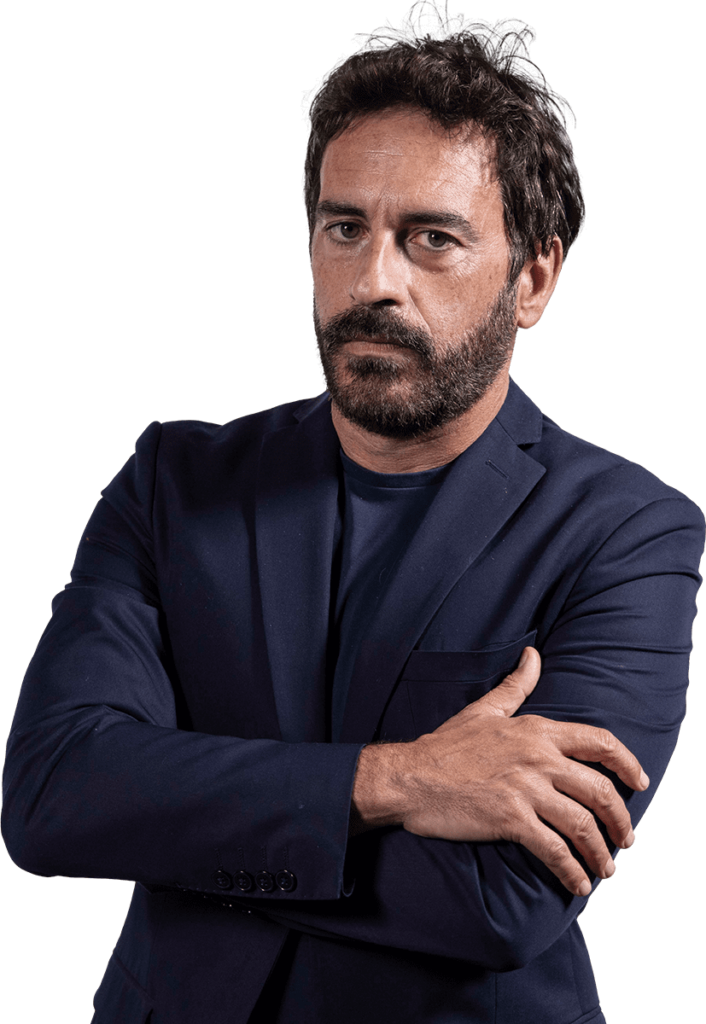
Riccardo
Ajossa
Chairholder and Senior Lecturer in Paper Technologies at the Academy of Fine Arts in Rome.
She studied Painting at the Academy of Fine Arts in Rome and was a scholarship holder at Loughborough College of Art and Design, where she specialised in Paper Making. He obtained a Master’s Certificate in the History of Modern Art from the University of Amsterdam. He attended communication seminars at the Landmark School in New York.
He has been invited to present his research on paper as a medium for the production of contemporary art at the Marmara University Fine Arts Academy in Istanbul, the Academy of Fine Arts in Leipzig, the FBAUL in Lisbon, Cornell University and the Faculty of Art in Halle, culminating in an invitation from the Venice Biennale, which invited him to undertake a residency at the Ca’ Foscari venue to curate the second masterclass in the institution’s history, ‘Segni d’acqua’. The work carried out was video-documented and produced by the Biennale, and is preserved in its historical archive.
His idea of producing oriental paper using Western methods attracted the interest of institutions such as the Embassy of the Republic of Korea in Italy and the Korean Cultural Institute in Italy, which invited him to Seoul for a university research project aimed at expanding his knowledge of the techniques used to produce traditional Hanji paper.
The work carried out in Morocco from 2011 onwards to establish a paper mill in collaboration with the Lalla Amina orphanage, as part of an international cooperation exchange supported by the Italian Embassy and with a social purpose and focus, is fully documented in the 2013 art publication ‘Paper beyond surfaces’ by the Il Cigno publishing house, presented by the writer Tahar Ben Jellun on the occasion of the exhibition summarising the artist’s ten years of experimentation with handmade paper, held at the San Salvatore in Lauro Museums in Rome.
His works of art can be found in the collections of museums such as the Venice Biennale, the Carlo Bilotti Museum Collection in Rome, the Castro Pretorio National Library in the Vatican City, the Pontifical Council for Culture in Athens, the Benaki Museum, and the São Paulo Biennial Institute in Brazil.
His most notable exhibitions include: Incerticonfini in 2017 and Trame Lontane in 2019 at Spazio Nuovo Contemporary in Rome; the United Nations Headquarters in New York in 2013; the Hush Gallery in Istanbul in 2014; the Tonspur Museum in Vienna in 2014, under the patronage of the Italian Embassy; the AICA Foundation in Milan in 2015; the MAT Museum in Rome in 2015; the CAMUSAC Museum of Contemporary Art in Cassino, Italy, in 2017; and the Espaço 321 Gallery in São Paulo, Brazil, in 2017, under the patronage of the Italian Embassy in Brazil.
The Paper Technologies course is workshop-based and combined with a significant theoretical component, which is essential for developing an appropriate personal research project.
The first part of the course is divided between theoretical-historical lectures on the production of handmade paper and its relationship with contemporary art, drawing on relevant anthropological studies. Screenings of specific video documentaries from the course archive, featuring rural paper mills producing plant-fibre paper in various regions, such as China, Japan, Korea and India, as well as an overview of the materials commonly used in contemporary art production. The role of paper in the dissemination of culture and in art production as a vehicle for the spread of ideas will also be analysed through dedicated lectures on the presence and use of paper in contemporary art production.
The practical component focuses on the construction of the basic equipment required to set up an artisanal paper workshop. This includes constructing the frame, preparing the watermark, and breaking down and dyeing the paper pulp obtained from cotton rags or plant fibres. Particular attention will be paid to the production of Korean Hanji paper, given the workshop’s specialisation in research into this paper, thanks to a long-standing international collaboration with the Korean government and the Korean Cultural Institute in Rome. The use of the Korean frame and vat is facilitated by the availability of the original equipment in the classroom.
Paper will be made from the bark and fibres of trees and shrubs such as kozo, dak, mitsumata and lochka, or from local Italian fibres sourced directly by the participants, which will be transformed into a substrate using the traditional method of boiling and hand-beating.
An in-depth study of natural dyes, using pigments extracted from berries, roots and minerals, will form an integral part of the research and will complement the participants’ knowledge of the use of artistic materials essential for their own work. An integral part of the research will be the search for individual natural materials sourced directly from the natural environment, with the aim of establishing a profound connection with the location.
Here, paper can be conceived as a mirror and a yardstick for human action and behaviour within the landscape, as well as a testament to individual reflection. The workshop is the space where complex creative thinking engages with the need for a rigorous and meticulous technical-scientific process, enabling art to find its own eloquent and distinct expression as a mediation between gesture and result.
Exploring the possibility of creating a ‘medium’ (paper) using materials available in the given circumstances lays the groundwork for a dedicated session focusing on the production of recycled paper, also as an aspect of eco-sustainability. We will contextualise the participant’s design skills, helping them to position their work within the contemporary concept of art, without overlooking the educational potential of the workshop as a space for enhancing the individual’s expressive abilities. Engaging with the material by managing its structural dynamics, creating shapes and volumes, and experimenting with paper in ways never previously imagined.
D. Hunter, ‘The History and the Technique of an Ancient Craft’, Dover
Barrett, ‘Japanese Papermaking’ – Floating Word Editions
Basanoff, ‘Itinerario della carta da oriente a occidente’, 1965, Il Polifilo
J. Martin, ‘Storia e potere della scrittura’ – Laterza
McLuhan, ‘The Gutenberg Galaxy’ – Armando
F. Brunello, “L’arte della tintura nella storia dell’umanità” – Neri Pozza
Brique, “La catalogazione delle filigrane”
Gli strumenti del comunicare, M. McLuhan, Edizioni Il Saggiatore, Maestri del 900 M. McLuhan. Il Saggiatore, Maestri del 900
A Walking Life, R. Solnit. Mondadori
Thar Ben Jollun, Il libro del buio. Einaudi
Darwin, The Voyage of a Naturalist Around the World. Newton Compton Great Value Paperbacks
Darwin, On the Origin of Species. Newton Compton Large Paperback Value Editions