Patrizia
Bisonni
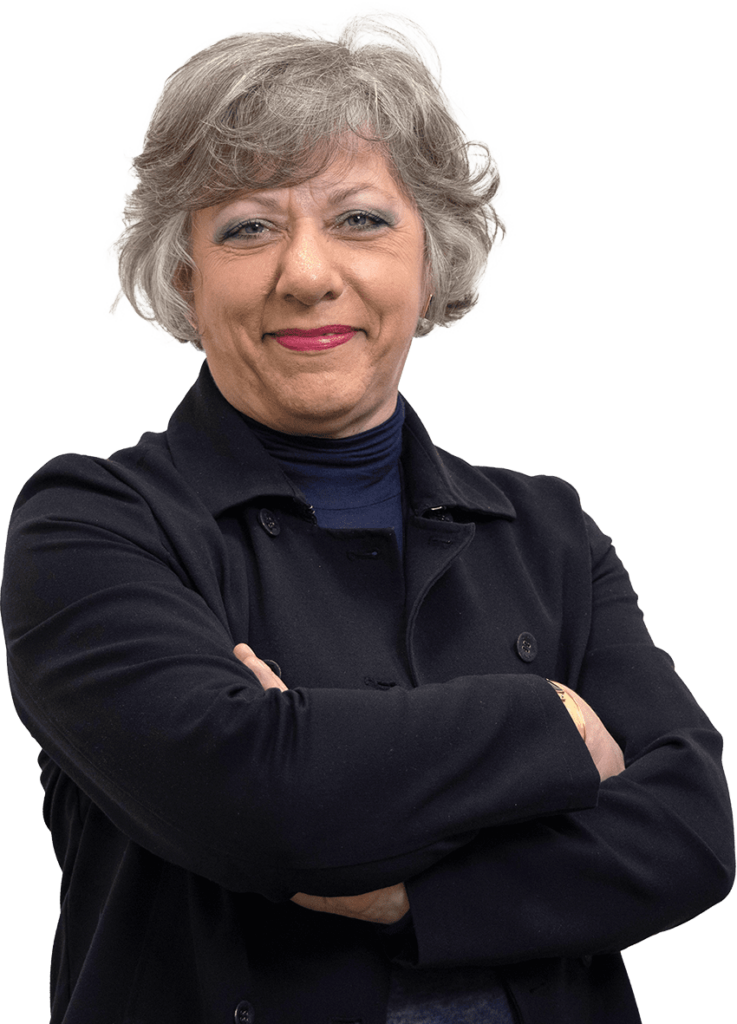
Patrizia Bisonni was born in Terni (Umbria).
A lecturer in SCULPTURE, she trained at the ‘Pietro Vannucci’ Academy of Fine Arts in Perugia, where she was a student of Eliseo Mattiacci, Bruno Corà and Edgardo Abbozzo, who wrote of her: ‘P.B. pursues her sculptural exploration with a focus on metals, from the so-called “noble” metals to copper, brass and bronze, employing assemblage, eliminating mass, fragmenting, and imbuing her work with Drawing, Mark and an ability to evoke other Times and Spaces.’
Since 1981, she has combined her artistic research with technical collaborations in theatre, under the direction of Franca Valeri, in cinema, for Roberto Bertolucci, and in ceramics and jewellery. She has participated in conservation and restoration projects for the ‘Cavalleresco del Pisanello’ cycle at the Mantua Superintendence of Artistic and Historical Heritage as a researcher.
She has been teaching since 1990. After winning a national competition, in 1998 she began her career as a Lecturer in Sculpture at the Academy of Fine Arts in Carrara, where in 2000 she took part in the 10th Carrara International Biennial of Contemporary Sculpture.
Since 2005, she has been teaching at the Academy of Fine Arts in Rome, where she lectures on SCULPTURE and Ceramic Techniques.
Since 2002, she has been coordinating students at the Academy Symposia, fostering an ongoing dialogue and collaboration between lecturers for the benefit of students’ education. This has led her to gain national and international experience as a tutor for artist residencies focused on exploring the relationship between Art and Nature through contemporary artistic languages: ‘Extempore’ in Suvereto (GR), 2002; ‘Arte Pollino’ in Basilicata, 2015; the island of Tinos in Greece, 2017; ‘Giardini di Via Caravaggio’ in Pescara, 2019; and ‘HANAMI’ at the Botanical Garden in Rome, 2021, 2022 and 2023.
In 2008, she took part in the Erasmus programme for lecturers at the Universidad de La Laguna in Tenerife, Spain.
She taught at the Short Mobility Workshops organised as part of the European EU4Art project in 2022.
Her teaching programmes include workshops and participation in exhibitions with associations and university institutions, as well as events promoted by the municipalities of Terni and Narni, where she lives.
The aim of the course is to train professionals in the visual arts: artists, teachers and experts. This is achieved through the specific study of form, in close engagement with space – not only in indoor exhibition spaces, but also in nature, in urban and public spaces, within a genuinely expanded field, and in an ongoing relationship with technological developments and the surrounding context. To shape space plastically, through light and shadow, solid and void, lightness and heaviness, permanence and the ephemeral; to assemble, to construct places, to mark them, in order to give form to personal and collective experiences.
The aim is to offer all students practical workshop sessions, where theory and practice coincide. The course aims to stimulate creativity and social interaction, which are essential for the formation and development of a personal research process, by sharing a journey of growth through a wide range of experiences, from drawing life models to overseeing the graphic design for the presentation of works intended for exhibition, all the while maintaining a constant focus on the history of sculpture and the output of leading contemporary artists through visits to museums and exhibitions, art biennials, and participation in workshops, meetings and other experiences.
Throughout the year, the following activities will be offered:
- Drawing exercises from live models (male and female).
- Clay modelling tutorials.
- Video screenings of artists.
- Meetings with artists.
- Workshops focusing on materials:
- Linoleum, metals, clay, plaster, concrete, marble, wool, paper, and the following techniques: advanced casting, felt, and raku, with the participation of international artists.
- Recycling practices and use of materials.
- Development of individual and group projects with a view to participating in events. Exhibition practices.
- Visits to art venues, museums, parks and contemporary art exhibitions.
- Preparation for competitions.
Theoretical lectures on topics including ‘From Creativity to Form’ and ‘Artists from the 20th Century to the Present Day’; study visits to workshops specialising in large-scale production for public artworks; meetings with artists; participation in workshops aimed at producing works to be exhibited at events held in outdoor spaces, prestigious gardens and parks, and at festivals. Preparation for national and international competitions.
Teaching:
The workshop lectures, to be held in Room 13 at the main campus, will take place weekly on Tuesdays and Wednesdays in accordance with the academic calendar; off-campus sessions will be required for projects and workshops.
Exams and reviews:
At the end of each semester, in line with the deadlines set for competitions and participation in selections for proposed events, meetings will be arranged to review students’ work.
The exam consists of a discussion/presentation of the student’s artistic research and the programme they have completed, including technical data sheets for the works produced, and a PowerPoint presentation to be included in the class team. Personal portfolio containing drawings, sketches, summaries of visits to museums and exhibitions, and scheduled workshops.
Dissertation:
Dissertations will be accepted if requested at least one year before the scheduled final viva voce examination for the Diploma session and if supported by a lecturer in a theoretical subject.
Bibliography:
- ANSELM KIFER, Parole d’artista, Rosenberg & Sellier
- Wassily Kandinsky, Point, Line, Plane, Adelphi
- Plasmare il mondo – La scultura dalla preistoria a oggi, Einaudi
- Michelangelo Pistoletto – Il Terzo Paradiso, Marsilio
- Bill Viola, Vedere con la mente e con il cuore, Gangemi Editore
Fausto Melotti, La Melagrana Aperta, Edizioni della Cometa
In-person theoretical and practical lectures, Classroom 13, main campus, on the form and process of working with clay, meetings with ceramic artists, participation in workshops, visit to the MIC International Museum of Ceramics in Faenza (RA).
Students are required to design open and closed forms to be created in the classroom during in-person lectures.
The following topics will be covered:
Clays, working tools, utensils and techniques, body compositions, slab technique, coil-building or ‘colombino’ technique, textures and surfaces, slipware on biscuit clay, impression, engraving, carving, single firing and biscuit or first firing, RAKU technique.
Reviews:
During each lecture, the work produced in the previous lecture will be reviewed. A basic knowledge of clay as a material is required.
The review of the work carried out will provide access to the final examination covering the entire programme, which will include technical datasheets for the pieces produced, sketches, drawings and photographs, summary reports, and personal reflections.
Bibliography:
- Luciano Marziano, Ceramica è Arte, raccolta di testi critici e recensioni
- Manuale della Ceramica, Herry Memmot, ed. Brancato. Brancato.
- Decorazione Ceramica, Nino Caruso, Hoepli Editore.
- Recommended YouTube videos: Montelupo Fiorentino Ceramics School