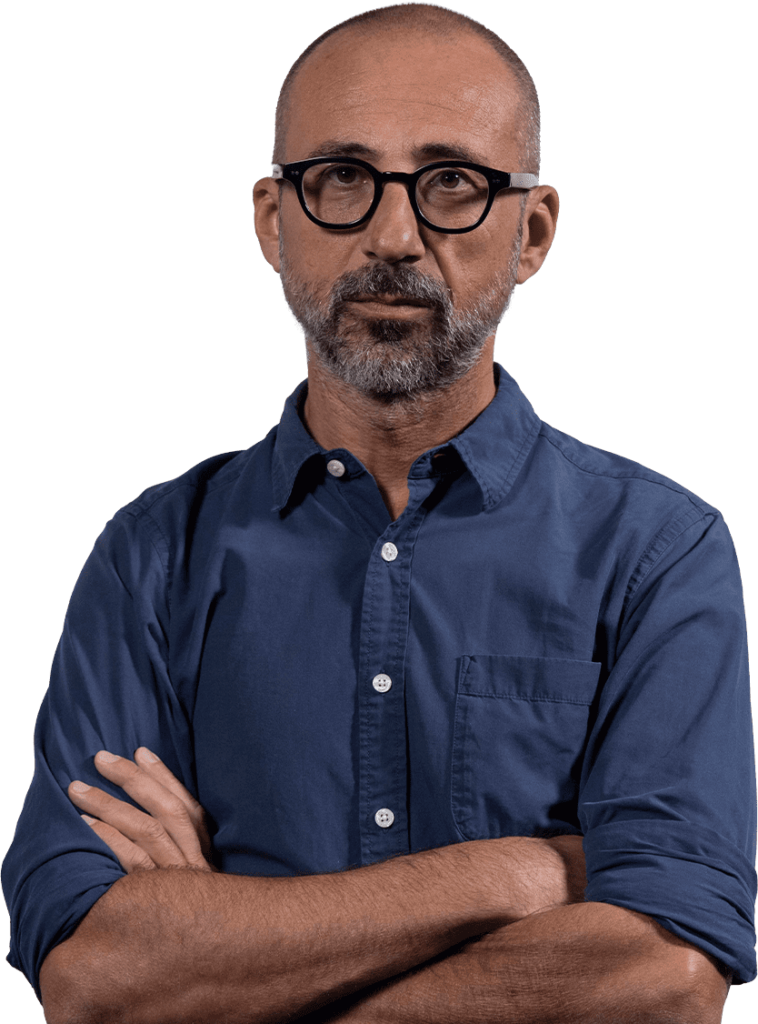
Pierluigi
Calignano
After studying at the Academy of Fine Arts in Brera, in 1995 he attended the Advanced Course in Visual Arts at the Ratti Foundation in Como with Visiting Professor Joseph Kosuth. From 2007 to 2016, he lived and worked between Italy and the USA, where he participated in programmes such as ISCP, New York; the I-Park Residency Program, East Haddam, Connecticut; and the Art Omi International Artist’s Residency, Ghent, NY. In 2016, he created a permanent public art installation at the Parkside Community Complex PISIS 437K in Brooklyn, New York. He has exhibited in solo and group shows at venues including DAFNA Gallery, Naples; Palazzo Lucarini Contemporary, Trevi; O’, Milan; LWZ Projekte, Vienna (AT); MARS, Milan; MAGA, Gallarate; Centre Culturel Français, Milan; Antonio Colombo Arte Contemporanea, Milan; Carbone.to, Turin; Salvatore+Caroline Ala, Milan; Groninger Museum, Groningen (NL); Fondazione Museo Pino Pascali, Polignano a Mare; Casa Masaccio, San Giovanni Valdarno; Fondazione Arnaldo Pomodoro, Milan; Wäscherei Kunstverein, Zurich (CH); Palazzo della Triennale, Milan; Spazio Oberdan, Milan; Röda Sten Museum, Gothenburg (SE); Tirana Bienniale, Tirana (AL); Viafarini, Milan; and Assab One, Milan. His work has been reviewed in Artforum, Flash Art, Exibart, Arte e Critica, Segno and Tema Celeste. He teaches Painting at the Academy of Fine Arts in Rome.
Course Content
Introduction
The landscape of contemporary artistic languages is in a state of constant transformation: the acquisition of and awareness of the means and tools of communication are called into question almost as soon as they take shape. To be able to observe and effectively address this relentless change, it is necessary to shift from the level of the finished work to that of the creative process, as an analytical and design concept, by conducting an analysis of the causes that determine one or more outcomes, in order to closely follow and understand the path of artistic creation in all its nuances.
For the 2022/2023 academic year, the Painting Course aims to shift the focus of study from the finished work to the process that gives rise to it and the language that lives within it. In this context, the acts of conception and creation are understood as successive stages in the most profound and distinctive development of the dialogue between the artist and their work. Indeed, it is this dialogue that reveals the meaning of the artist’s own exploration – the connection between what lies within and what the work expresses – because what is hidden deep within the artist’s intent is present in their work and is most evident in the dynamic of giving it form.
Objectives
The course will provide students with the analytical, practical and theoretical tools to approach the creative process with an awareness of the techniques and the means/languages used, following the path of a theoretical conception that is never separated from its practical realisation. Through practical exercises, theoretical lectures, class discussions and meetings with artists, students will be progressively guided towards a greater awareness of their own expressive and linguistic potential. At the same time, they will be introduced to the contemporary art scene, its dynamics and the basic tools for organising and promoting their work in a professional context.
Methodology
The course includes theoretical lectures, practical workshops and meetings with professionals from the Italian and international art scene.
The theoretical lectures will involve the analysis of selected artists based on predefined topics for discussion. The various artists and different artistic contexts will be presented through lectures accompanied by themed slide and video projections. Through questions and discussion points, students will be guided towards developing an independent approach to analysing the works and themes covered. Particular attention will be given to living artists and current phenomena, to enable students, through their own creative research, to develop and learn within a contemporary art culture.
The practical sessions are structured as in-class workshops and exercises aimed at highlighting the importance of academic practice and the study of the various linguistic elements through which an artwork communicates. The creation of the works will be viewed as a dynamic exploration of the diverse potential of pictorial means of expression and of various experimental languages, with the aim of defining coherent and effective personal trajectories.
With this in mind, students on the Level 1 Painting Course will be guided progressively, through targeted preparatory exercises, towards gaining awareness of their own expressive abilities, as they develop increasingly original and well-founded artistic projects and areas of exploration. This will be achieved through the gradual structuring of a personal artistic vision, which will be expressed in all aspects of their work, including the preparation of presentations for professional contexts.
Students on the Second-Level Painting Course will receive more close support as they explore the various aspects of their creative practice in greater depth, through a detailed examination of the quality of the works they produce, their personal artistic vision, and the presentation of their professional development. Particular attention will be given to aspects such as the structure of the portfolio, the drafting of the artist statement, the oral presentation of the work, the installation of the works in the exhibition space, and the study of the contemporary art scene and the art system.
Final assessment methods
– Attendance at lectures.
– Presentation of the work produced.
– Oral discussion of the topics covered in the theoretical lectures and assessment of the skills acquired.
Recommended reading
Various authors, Arte dal 900 – Modernismo, Antimodernismo, Postmodernismo, Zanichelli, Milan
Denys Riout, L’arte del XX secolo – Protagonisti, temi, correnti, Einaudi, Turin 2002
Recommended Reading
Georg W. Bertram, Arte. Un’introduzione filosofica, Einaudi, Turin
Silvia Bordini (ed.), Arte contemporanea e tecniche. Carocci, Rome, 2007
Nicolas Bourriaud, Estetica relazionale, Postmedia Books, Milan
Alessandro Del Puppo, L’arte contemporanea. Il secondo Novecento, Einaudi, Turin
John Dewey, Arte come esperienza, Aesthetica, Palermo
Umberto Eco, Opera Aperta, Bompiani, Milan
Hal Foster, Il ritorno del reale, Postmedia Books, Milan
Luciano Fabro, Arte torna arte, Einaudi, Turin
Mario Perniola, L’estetica contemporanea, Il Mulino, Bologna, 2011
Recommended websites
https://atpdiary.com/
https://www.contemporaryartdaily.com/
https://artviewer.org/