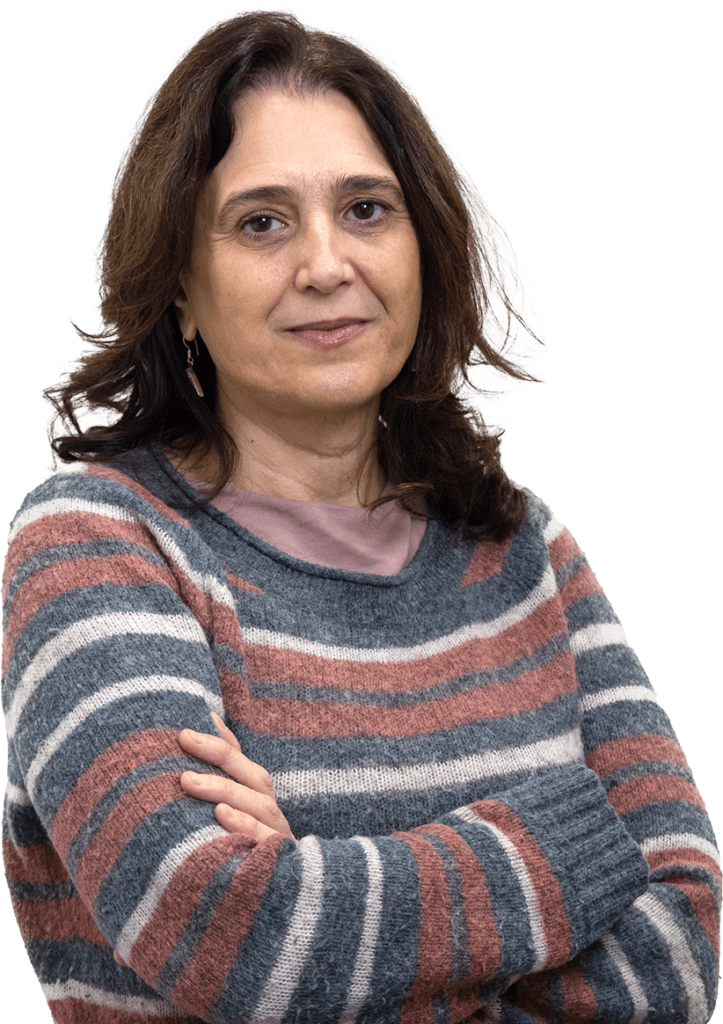
Gaetanina
Campisi
Gaetanina Campisi obtained a diploma in Painting from the Academy of Fine Arts in Florence in 1988 and, in 1990, specialised in printmaking at the Il Bisonte International School of Graphic Art in Florence. In her work, she employs various expressive media – printmaking, painting and photography – often in conjunction with installation art. Her themes reveal a strong connection with nature and its beauty, as well as with memory and the transience of all things. In 2009, she began to take an interest in new printmaking materials, with a particular focus on alternative methods for sustainable printmaking, taking part in and organising various workshops and events on these topics in Italy and abroad. Exhibitions: 2018 Villa Malfitano – Whitaker Foundation, Palermo, ‘Voyage a Palermo’, curated by Isabella Vitale and INARCH Sicilia. 2016 Galleria La Nube d’Ort, Rome, ‘Rituale di Primavera’, curated by Isabella Vitale. 2015 Interno 14, Rome, ‘Infinito Arcobaleno’, curated by Marco Rinaldi. 2014 Ospiti, Rome, Studio Elena Boni. 2004 ‘L. Di Sarro’ Centre, Rome, curated by Lea Mattarella. Rome, 2000 ‘Il Giardino’, Casa Ludovico Pratesi, curated by Lea Mattarella. 1999 ‘Una stanza tutta per sé’, Cantieri Culturali alla Zisa, Galleria Bianca, Palermo, curated by Lea Mattarella.
Currently teaches Artistic Graphic Design and Printmaking, and is Coordinator of the School of Artistic Graphic Design (Levels I and II) and of the Two-Year Course in Paper Materials Technology.
Programme
The course aims to provide students on the three-year programme with knowledge of the main printmaking techniques, enabling them to develop an artistic path and language within the framework of contemporary discourse. Starting with drawing and the analysis of the mark, students will be able to understand the potential and expressiveness of the visual signature in relation to the engraved mark. Drawing, painting and various graphic tools will be used to introduce students to the world of art, expanding the exploration as far as possible to include the media best suited to each student.
Practical work will be supported by short theoretical lectures, accompanied each week by tutorials and revision on assigned topics.
The workshop programme is a key part of the experience, enabling students to acquire technical skills in printmaking and printing. The materials and technologies used will be as sustainable as possible, with a strong focus on new methodologies.
The course includes visits to exhibitions and museums, workshops, and meetings with artists.
Exam format
Students shall present and discuss the work they have completed.
Bibliography
G. Strazza, “Il gesto e il segno”, Ed. Scheiwiller, Milan 1979.
R. Federici, S. Kraczyna, D. Viggiano, “I segni incisi”, ed. Il Bisonte, Florence 1985.
F. Genna, ‘Materiali e metodi per l’incisione sostenibile. Alcune esperienze’, ed. Navarra editore, Palermo 2015.
A. H. Hind, “La storia dell’incisione” ed. U. Allemandi, Turin 1998.
G. Mariani, Istituto Nazionale per la Grafica, ‘Le tecniche calcografiche dell’incisione diretta, bulino, puntasecca, maniera nera’, ed. De Luca, Rome 2001.
Programme
The Art Printmaking course aims to combine design methodology and artistic conception in order to produce an art print edition or an artist’s book. During the lectures, students will acquire both theoretical and practical skills and knowledge.
The lectures will cover the history of the artist’s book and art editions, the various engraving techniques, and, most importantly, the different printing methods, as well as general information on how to produce a print run, from wetting the paper to numbering and the colophon. In addition to achieving a successful artistic outcome, the complex process of developing an art edition aims to strengthen students’ understanding of and familiarity with the art research process. Students will develop their ideas based on a theme, following a process that begins with design and progresses to execution. There will be scope for technical experimentation, and particular attention will be paid to contemporary expression and sustainable materials.
The course includes visits to exhibitions and museums, workshops, and meetings with artists.
Exam format
Students shall present their completed work and provide an oral report on it.
Bibliography
Solomon, F., “Il conoscitore di stampe”, Allemandi, Turin 1960
Jentsch, Ralph, “I libri d’artista italiani del novecento”, ed. Allemandi, Turin 1993
G. Maffei, “Il libro d’artista”, ed. Sylvester Bonnard, Milan 2003.
A. Moeglin-Delcroix, L. Dematteis, G. Maffei, A. Rimmaudo, “Guardare Raccontare Pensare Conservare. Quattro percorsi del libro d’artista dagli anni Sessanta ad oggi”, Quattro percorsi del libro d’artista dagli anni Sessanta ad oggi”, ed. Corraini, Mantua 2004.
S. Parmigiani, C. Mingardi, “Parole disegnate, parole dipinte. La collezione Mingardi del libro d’artista”, ed. Skira, Geneva–Milan, 2005.
https://www.moma.org/collection/works/?classifications=5&include_uncataloged_works=1
https://www.moma.org/s/ge/collection_ge/allworks/allworks_thumbs.html