
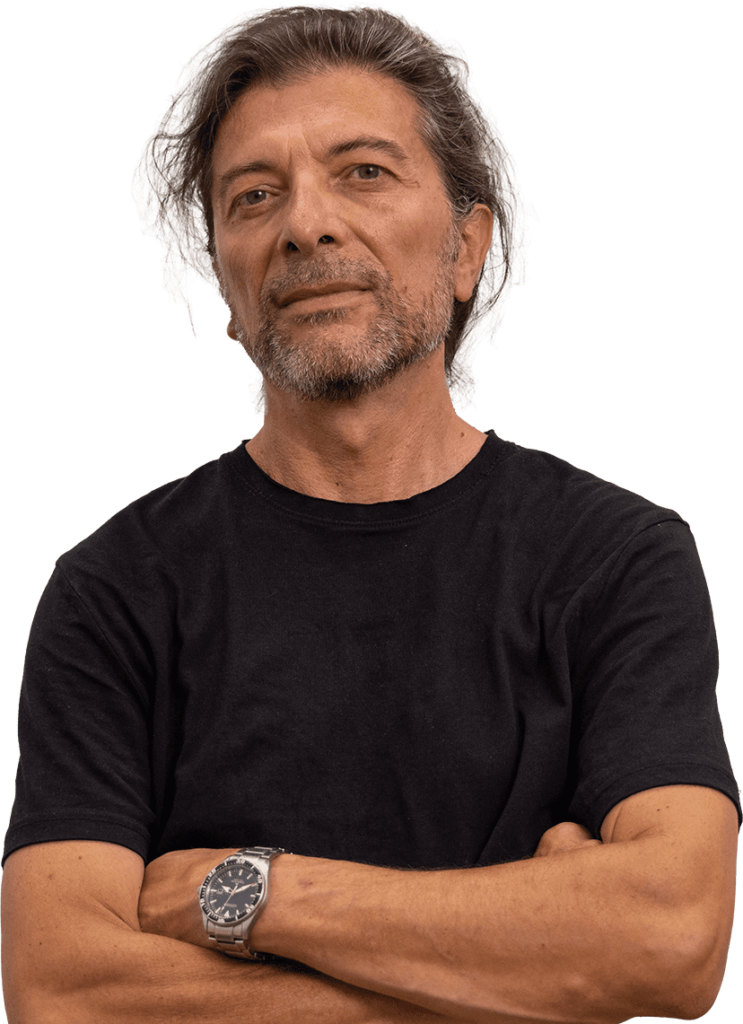
Carlo
Pettinelli
Photographer, trainer, photography teacher, counsellor, and facilitator of personal development and self-observation workshops. After graduating in Statistics, he devoted himself entirely to photography, producing reportage work and collaborating with Italian and international magazines, publishing houses, photography agencies and companies, for which he has overseen communication projects. He collaborates with exhibition spaces and galleries in Italy and abroad, and over the years, he has held numerous exhibitions, received prizes and awards, and had his photographs included in both public and private collections. In 2005, he began training and teaching photography, both in state schools and on private courses. Since 2014, he has been teaching at the Academy of Fine Arts in Rome. In 2018, he obtained a two-year Counsellor diploma from the Italian Society of Therapeutic Psychosynthesis in Florence, with a thesis on the use of photography in the therapeutic relationship, and specialised in the use of therapeutic photography, leading numerous creative and self-representation workshops.
2014–2020 Photography tutor at the Quasar Institute for Advanced Design.
2006–2017 Teacher of analogue and digital photography at the City of Rome’s School of Art and Crafts.
2010 Second prize at the ‘International Photography Awards’ in Los Angeles.
2009 ‘L’Unica Città Che Amo’ (‘The Only City I Love’), permanent exhibition at the Lu.C.C.A. Lucca Center of Contemporary Art.
2007 ‘Segni di Confine’ (Border Marks), exhibition at the ARTIST 2007 event in Istanbul.
Programme (generally applicable to all Photography courses)
The aim of this educational programme is to equip students with all the knowledge they need to use modern photographic equipment with sufficient skill and awareness, while at the same time embarking on a personal journey to develop their own creative voice through the medium of photography.
The course will cover topics related to classical and modern theory, photographic shooting in practice, the creators of contemporary photography, and the development of a photographic project.
Classical theory: photographic lenses, their characteristics and use (focal length, angle of view, depth of field, perspective); main camera parameters (shutter speed–aperture–ISO); light measurement (with and without automatic functions).
Modern photography: what changes with digital technology (files, formats and resolution; mirrorless/SLR; sensors and reproduction ratios; storage media; data backup); adjusting settings (new camera control settings, optimising the camera menu; creative use of automatic functions).
Practical work: Shooting techniques (approach to taking photographs both in the studio and outdoors); general rules of composition; managing light (natural, artificial, continuous and flash); workflow management; organising a project: from conception to taking the photographs, selecting them and creating the final portfolio.
Contemporary photography: Contemporary photographers (in line with the individual course of study) will be presented, with a focus on young artists, in order to identify a trajectory in the evolution of photography from which students can draw ideas for reflection and inspiration for their own personal work, as explored within the individual module.
The learning pathway will be enhanced by practical exercises (both in the classroom and independently) and by reviews of the work produced (both in groups and individually), culminating in the creation of a photography portfolio, based on a common theme, for the examination project.
TRATTATO DI FOTOGRAFIA MODERNA – M. J. Langford (all editions)
MANUALE COMPLETO DI FOTOGRAFIA – E. Maddalena, 2012 Hoepli Ed.
FOTOGRAFIA – G. Forti, Ed. Reflex
LA FOTOGRAFIA CONTEMPORANEA – M. Poivert, 2011 Einaudi Ed.
On Photography – Susan Sontag, 1978, Einaudi Ed.
LA CAMERA CHIARA – R. Barthes, 1980 Einaudi Ed.
LA FURIA DELLE IMMAGINI – J. Fontcuberta, 2016 Einaudi Ed.
iREVOLUTION – I. Alison, 2015 Postcart Ed.
BLACK OUT DELL’IMMAGINE – R. Panattoni Bruno, 2013 Mondadori Ed.
LE IDEE DELLA FOTOGRAFIA – C. Marra, 2001 Mondadori Ed.
H. C. Bresson, LO ZEN E LA FOTOGRAFIA – J. P. Montier, 1996 Leonardo Arte Ed.
MAN RAY, Sulla fotografia, edited by Janus – translated by M. Vitta, 2006 Abscondita Ed.
PENSARE PER IMMAGINI – L. Ghirri, 2013 Electa Ed.
MARIO GIACOMELLI – G. Celant, 2001 Logos Ed.
The aim of this educational programme is to equip students with all the knowledge they need to be able to use modern digital photography equipment with sufficient skill and awareness while at the same time embarking on a personal journey to establish their own creative identity through the medium of photography. To achieve this, the course will cover the following main phases (below is a list of the principal topics that will be addressed, the level of detail of which will vary according to the year of the course):
Traditional theory: PHOTOGRAPHIC LENSES (focal length; angle of view; depth of field; perspective); KEY CAMERA SETTINGS (shutter speed–aperture–ISO; light metering with and without automatic functions).
Digital theory: WHAT CHANGES IN DIGITAL PHOTOGRAPHY (files, formats and resolution; mirrorless/SLR; sensors and reproduction ratios; storage media; data backup); ADJUSTING SETTINGS (camera menu; new camera control settings; creative use of automatic functions).
Practice: SHOOTING TECHNIQUES (approach to shooting both in the studio and outdoors; general rules of composition); WORKFLOW MANAGEMENT (organising a project: from conception to taking the shots, selecting the shots and assembling the final portfolio).
Contemporary photography: Contemporary photographers will be presented alongside classical photographers in order to identify a trajectory of evolution in photography from which students can draw food for thought and inspiration for their own work.
The learning pathway will be enhanced by practical exercises (both in the classroom and independently) and by reviews of the work produced (both in groups and individually), in order to prepare students for the examination as effectively as possible.