Marcello
Gallucci
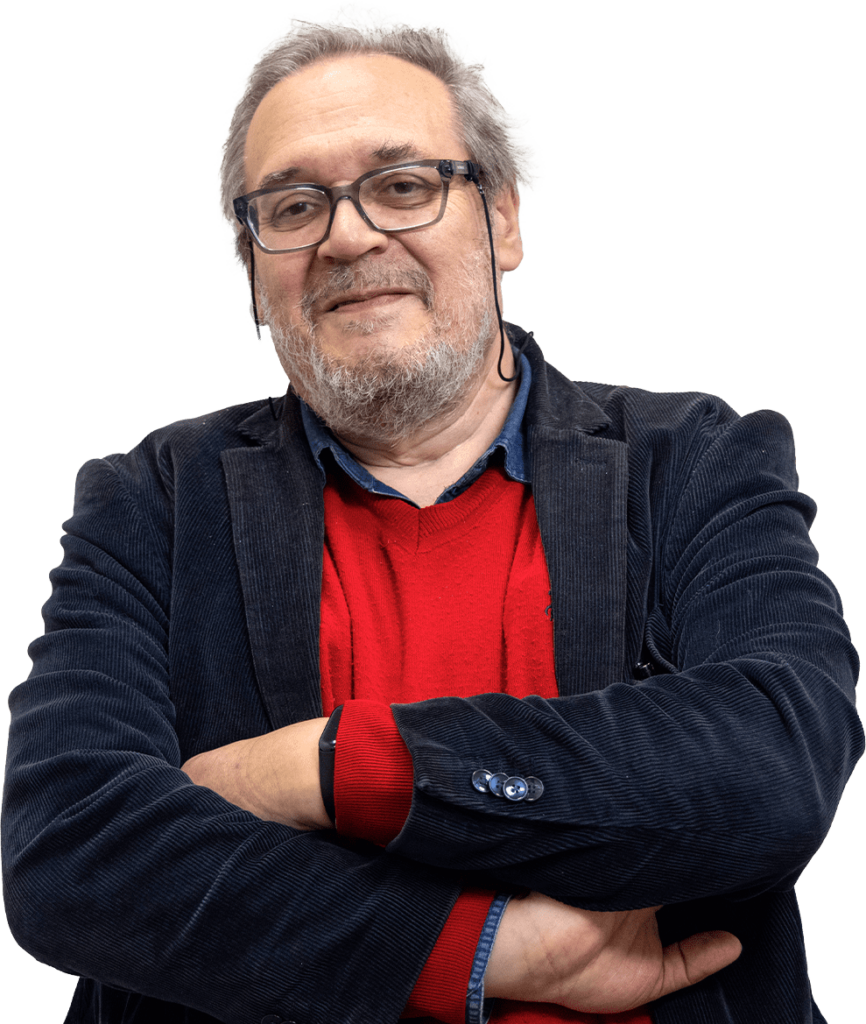
I love the Beatles, De André, Paolo Conte and Leonard Cohen. Not in that order, not as a priority, and not exclusively. I play the guitar – quite badly, but I’m not ashamed of it. I love motorbikes: not the ‘cool’ ones, but the kind that let you go on long solo journeys. I studied philosophy (a long time ago): I still carry a certain habit from it, or perhaps a hidden vice that I cannot conceal. I have devoted almost all my research to Antonin Artaud and to the way in which his ideas intersect with, subvert or shape 20th-century theatre. I have been, and continue to be, a ‘fellow traveller’ for many theatre practitioners seeking a different way of being present on stage. An exploration of the origins of the new approach to the art of acting led me to reread Kierkegaard, going beyond my initial fascination with his ideas. I am obstinate, stubborn, and I do not like being contradicted. I gladly smile at those who take me too seriously.
Title of the single-subject course: Theatre Direction as Utopia: The Auditor by V. E. Meyerhold.
N.B.
Over the course of the semester, seminars, meetings and discussions will be offered, adopting a strictly interdisciplinary approach and in collaboration with related departments; these will form an INTEGRAL PART of the examination programme. The list of events will be announced at a later date. Prominent names include Andrea Piersanti, who has overseen virtual reality for films such as The Secrets of Dumbledore, Doctor Strange in the Multiverse of Madness, etc.;; OPERA TEATRO, the company founded by Vincenzo Schino and Marta Bichisao, with whom we already met last year; Ornella Calvarese, one of Italy’s leading Eisenstein scholars, who will speak on the mad clowns of the Byzantine tradition; Anna Tellini, a Slavonic scholar, researcher and performer of Meyerhold; Mario Biagini, director, heir to and continuator of Grotowski’s legacy; Alessio Arena, an accredited expert of the Dario Fo and Franca Rame Foundation; Lina Della Rocca, actress and co-founder of the Teatro Ridotto in Bologna; and others.
FOR INTERNATIONAL STUDENTS
International students are strongly encouraged to contact the lecturer at the start of the course so that any alternative arrangements can be made.
DISSERTATION
The thesis topic must be agreed upon AT LEAST ONE YEAR before the viva voce examination: during this period, students shall be required to regularly check the status and progress of their research and writing with the lecturer. Failure to comply with this rule shall constitute a sufficient and indisputable ground for disqualification. Dissertations in the History of Performing Arts may only be requested after passing the examination.
READING LIST
a) General section
A history of theatre, chosen by the student (among the many available on the market, I recommend C. Molinari, Storia del Teatro, Laterza, or R. Alonge and R. Tessari, Manuale di Storia del Teatro. Fantasmi della scena d’Occidente, UTET Università, or R. Alonge and F. Perrelli, Storia del teatro e dello spettacolo, UTET Università. However, there are numerous other excellent texts that can be used, from G. Wickham to A. Attisani, Luigi Allegri and Ilaria Godino).
b) SINGLE-SUBJECT COURSE: The Government Inspector by V. E. Meyerhold
N. V. Gogol, The Government Inspector (or The Inspector General) – any edition.
V. E. Meyerhold, The Government Inspector, edited by A. Tellini, CUE Press;
A.M. Ripellino, Il trucco e l’anima, Einaudi
N.B. The text by A.M. Ripellino may be replaced with:
B. Picon-Vallin, Mejerchol’d, MTTEdizioni, or
A.M. Ripellino, Majakovskij e il teatro russo d’avanguardia, Einaudi, or alternatively
Vs. E. Meyerhold, The Biomechanical Actor, CUEU.
For the avoidance of doubt, I would like to specify that candidates MUST study both the single-subject course and the general section. Various translations of The Government Inspector are available online. However, we recommend the Garzanti edition, with an introduction by F. Malcovati.
Title of the single-subject course: Foundations of Tragedy: Medea
N.B.
Over the course of the semester, seminars, meetings and discussions will be offered, adopting a strictly interdisciplinary approach and in collaboration with related departments, which will form an INTEGRAL PART of the examination programme. The list of events will be announced at a later date. Prominent names include Andrea Piersanti, who has overseen virtual reality for films such as The Secrets of Dumbledore, Doctor Strange in the Multiverse of Madness, etc.; OPERA TEATRO, the company founded by Vincenzo Schino and Marta Bichisao, with whom we already met last year; Ornella Calvarese, one of Italy’s leading scholars on Eisenstein, who will speak on the mad clowns of the Byzantine tradition; Anna Tellini, a Slavic scholar and expert on Meyerhold; Mario Biagini, a director who has inherited and continued Grotowski’s legacy; Alessio Arena, an accredited expert of the Dario Fo and Franca Rame Foundation; Lina Della Rocca, an actress and co-founder of the Teatro Ridotto in Bologna; and others.
FOR INTERNATIONAL STUDENTS
International students are strongly encouraged to contact the lecturer at the start of the course so that any alternative arrangements can be made.
DISSERTATION
The thesis topic must be agreed upon AT LEAST ONE YEAR before the viva voce examination: during this period, students shall be required to regularly check the status and progress of their research and writing work with their lecturer. Failure to comply with this rule shall constitute a sufficient and undisputed ground for disqualification. Dissertations in Theatre Literature and Philosophy may only be requested after passing the examination.
Reading list
For students attending lectures, the reading list and lecture notes will be provided over the course of the year. Students not attending lectures must base their preparation on an in-depth knowledge of Euripides’ Medea (any edition; the translation by Angelo Tonelli is recommended) and two volumes of their choice from the following list:
G. Steiner, Death of Tragedy, Garzanti;
P. Szondi, Teoria del dramma moderno, Einaudi;
A. Heller, Tragedia e filosofia, una storia parallela, Castelvecchi;
A. Badiou, Rhapsody for Theatre, Luigi Pellegrini Editore
Jan Kott, Divorare gli dèi. Un’interpretazione della tragedia greca, Bruno Mondadori; An Interpretation of Greek Tragedy, Bruno Mondadori.
J.-P. Vernant, P. Vidal-Naquet, Myth and Tragedy in Ancient Greece, Vol. I, Einaudi
D. Susanetti, Il teatro dei Greci, Carocci
N.B.
Over the course of the semester, seminars, meetings and discussions will be offered, adopting a strictly interdisciplinary approach and in collaboration with related chairs; these form an INTEGRAL PART of the examination programme. The list of events will be announced at a later date. Prominent names include Andrea Piersanti, who has overseen virtual reality for films such as The Secrets of Dumbledore, Doctor Strange in the Multiverse of Madness, etc.; OPERA TEATRO, the group founded by Vincenzo Schino and Marta Bichisao, with whom we already met last year; Ornella Calvarese, one of Italy’s leading scholars on Eisenstein, who will speak on the mad clowns of the Byzantine tradition; Anna Tellini, a Slavic scholar and expert on and performer of Meyerhold; Mario Biagini, director, heir to and continuator of Grotowski’s legacy; Alessio Arena, an accredited expert of the Dario Fo and Franca Rame Foundation; Lina Della Rocca, actress and co-founder of the Teatro Ridotto in Bologna; and others.
FOR INTERNATIONAL STUDENTS
International students are strongly encouraged to contact the lecturer at the start of the course so that any alternative arrangements can be made.
DISSERTATION
The thesis topic must be agreed upon AT LEAST ONE YEAR before the viva voce examination: during this period, students shall be required to regularly check the status and progress of their research and writing with the lecturer. Failure to comply with this rule shall constitute a sufficient and indisputable ground for disqualification. Dissertations in the History of Performing Arts may only be requested after passing the annual examination.
READING LIST
A. Artaud, Il teatro della crudeltà, in Il teatro e il suo doppio, Einaudi
A. Artaud, Messaggi Rivoluzionari, edited by M.G., with an essay by the same author, Jaca Book 2021
F. Cruciani, C. Falletti (eds.), Civiltà teatrale nel XX secolo, Il Mulino – Online PDF