
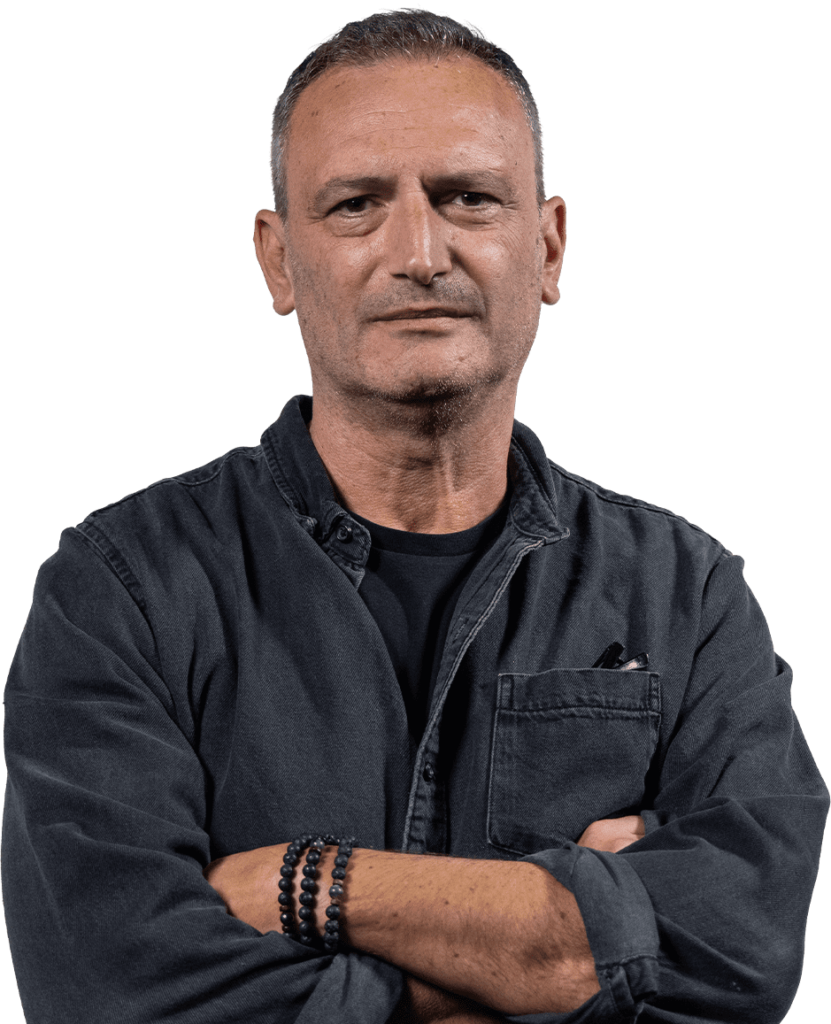
Tullio
Gubinelli
Since 1984, he has worked as a lighting designer for live music and fashion shows, including performances by artists such as De André, Pino Daniele, Eros Ramazzoti, Zucchero, Giorgia, B.B. King, Ray Charles, Vasco and Springsteen.
Fashion shows for Armani, Gucci, Fendi, Gay Mattiolo, Tod’s and others.
In 1994, he obtained a Diploma in Video Production and Direction of Photography through a course run by the Lazio Region.
In 1995, he obtained the qualification of cinematographic Director of Photography through a master’s degree at Cinecittà A.I.C.
Since 1995, Director of Photography on TV for programmes including: Taratata, Furore, Giochi senza frontiere, Moby Dick, Blu notte, Samarcanda, La famiglia, Servizio pubblico (2011, 2012, 2013, 2014), Cuochi e fiamme, Effetto domino, Grande Fratello, Ciao Darwin, Beato fra le donne, Uno di noi (Gianni Morandi), Avanzi, Moda sotto le stelle, Napoli punto e a capo, Moda mare a Positano, Tg5, and Matrix Chiambretti.
Since 1995, he has worked as a cinematographer in the film industry, contributing to the production of films such as Day Light (3rd unit cinematographer), Gangs of New York (12th unit cinematographer), Il campione e la contadina, La fabbrica, Palcoscenico, Il ventre di Palermo, Acab, Gladiator 2, Orizzonte, etc.
He has been teaching Cinematography since 2013 at the Academy of Fine Arts in Macerata and since 2022 at ABARoma.
Learning Objectives
The objective of the Direction of Photography course is to train professional cinematographers. The course will include teaching modules on the history of cinema and the analysis of film works, as well as in-depth technical and artistic study of both analogue and digital cinematography.
The course focuses on providing knowledge of the elements that make up the language of cinema, the technical equipment used, and the various roles that comprise a film crew. By studying the basic elements of lighting, students learn about the work of gaffers, grip technicians, assistant cinematographers and camera operators. The training continues with digital literacy, which involves understanding the fundamental nature of the video signal. Practical sessions on cinematographic filming techniques will be held with the participation of all students. Over the course of the year, students are involved in the production of film projects.
The study of cinematic language will be explored in depth, with a particular focus on lighting and image composition. Students will gain practical experience in digital technology, from the roles of data manager to DIT and from conforming to colour grading, as well as theoretical and practical training in the use of the Ronin and all the equipment provided by the Academy. These studies and activities culminate in the production of several series of short films.
Mode of delivery
In-person lectures.
Examination method
The exam will consist of a number of questions covering essential technical knowledge and the presentation of a video clip of up to 3 minutes on a free-choice topic, produced by each student without any post-production work.
Prerequisites
No specific prerequisites are required.
Course content
1. Introduction to the physics of light.
2. Characteristics of light.
3. How to use sunlight.
4. Correct exposure, including reading apertures with the aid of light meters.
5. Colourimetry in the context of digital photography.
6. Practical exercises in setting up a film set from the perspective of electricians and grip operators.
7. Practical exercises on the work of the assistant cinematographer, including in-depth knowledge of lenses and tripods.
8. Practical exercise on the work of the camera operator. Framing and cinematographic language.
9. Knowledge of cameras.
10. Production of various audio-visual clips in different expressive forms: reportage, documentary, TV series, horror, science fiction, etc.
11. Artistic use of all technical cinematographic components.
Vittorio Storaro, Scrivere con la luce (Mondadori Electa).
Monica Pollini, La luce come emozione.
Giuseppe Pinori, La luce come compagna (Light as a Companion).
Orio Caldiron, Giuseppe Rotunno e la verità della luce.
Alberto Spadafora, La luce necessaria (The Necessary Light).