
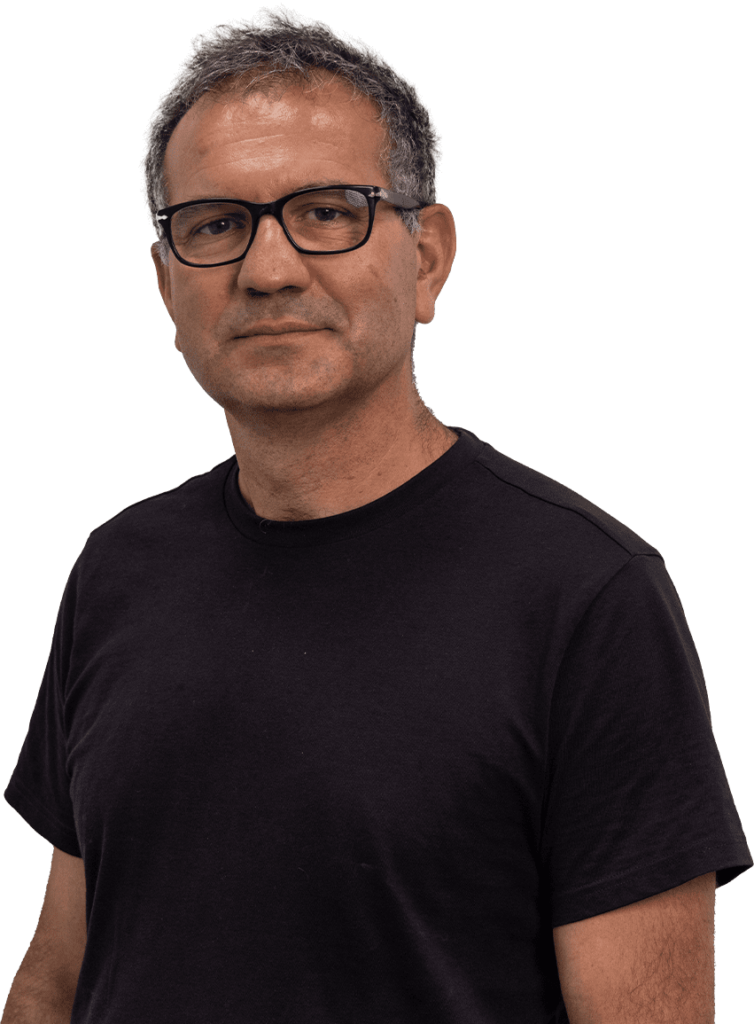
Piero
Mottola
Piero Mottola is an artist and experimental musician who teaches Sound Design, Audio and Mixing at the Academy of Fine Arts in Rome. He is the director of the LER Laboratory of Noise Aesthetics, founded in 1996, a research centre focusing on the relational and emotional aspects of noise. His training takes place within the framework of Eventualist Theory at the Jartrakor Study Centre in Rome, where, since 1988, he has been studying the subjective response and free interpretation of the listener/viewer to visual and sound structures, through experiments and measurements, and where he held his first solo exhibition, Miglioramento Peggioramento e Bello Brutto. He has been invited by several international universities to give lectures and deliver master’s programmes on the relationship between noise and emotion. The results of these research projects were published in the book Passeggiate emozionali, dal rumore alla Musica Relazionale, which has been presented at various Italian and international universities and featured in cultural broadcasts by Italian radio and television (Rai Uno, Rai Radio Tre), Radio Cultura Argentina, ZDF (German national television), MDR (German national radio) and RTS (Radio Télévision Suisse). This research has also been presented at various international museums and institutions: FIAC Grand Palais, Paris (1992); Palazzo delle Esposizioni, Rome (1993); Artissima Lingotto Fiere, Turin (1994); Galleria Pino Casagrande, Rome (2003 and 2010); Fondazione Volume and RAM Museo Radioartemobile, Casa dell’Architettura, Rome (2010); Fondazione Spazio13, Warsaw (2010); Fondazione Signum, Venice (2010); Hochschule für Musik und Theater, Leipzig (2011, 2014); 54th Venice Biennale (2011); Institut für Kunstpädagogik, Leipzig University (2011, 2014, 2021, 2022); 11th Havana Biennial (2012); Galleria OltreDimore, Art Basel, Basel (2012); 2nd China–Italy Biennial in Beijing (2013) and Turin (2015); MAMBA Museo de Arte Moderno, Buenos Aires (2013); Galleria Nazionale d’Arte Moderna, Rome (2013); 4th End of the World Biennial in Chile (2015); EAC Escuela de Actores de Canarias, Tenerife (2016, 2018); Polytechnic University of Valencia (2015); MACRO Museo d’Arte Contemporanea, Rome (2015, 2017); Museo Hermann Nitsch – Fondazione Morra, Naples (2009, 2015); MAC Museo de Arte Contemporanea, Santiago de Chile (2016); 4th China–Italy Biennial, Art District 798, Beijing (2016); Beijing Institute of Graphic Communication (2017); Contemporary Cluster Gallery, Rome (2018); Italian Cultural Institute in Beijing (2017); Academy of Fine Arts, Warsaw (2017); Miami River Art Fair, Miami (2017); ISA Universidad de las Artes, Havana (2017, 2019); Contemporary Cluster Gallery, Rome (2018); Fondazione Morra – Casa Morra, Naples (2018); Shanghai University (2018); Certosa di S. Martino, Castel S. Elmo, Naples (2018, 2019); CCK Kirchner Cultural Center, Buenos Aires (2019); Italian Cultural Institute, Buenos Aires (2019); Fudan University, Shanghai (2019); Museo Nacional de Bellas Artes, Havana (2019); MAD Murate Art District, Florence (2019); MArTA Museo Archeologico Nazionale, Taranto (2020, 2021); 14th Havana Biennial (2022); Auditorium Parco Della Musica, Rome (2022); Auditorium Institut für Kunstpädagogik, Leipzig University (2022); BienalSur, Buenos Aires (2023); International Red Cross Museum, Geneva (2024); XV Bienal De La Habana (2025); Fondazione Morra / Archivi Living Theatre, Caggiano (2025); Bauhaus Museum, Berlin, Weimar, Dessau (2025).
To find out more about Piero Mottola, please see the PDF:
Student Communications Team code: 9hsnihb
The course is divided into five sections, beginning with an introduction to the aesthetics of sound and noise and their relationship with the visual arts from antiquity to the present day, followed by practical experience aimed at developing technical knowledge of software for editing, manipulating and recording sound and noise.
Part One
Introduction to total art from antiquity to the present day.
Part Two – Artistic and musical avant-gardes
Art and Music in the Early 20th Century.
Luigi Russolo and the improvisation of Futurist music.
Edgar Varèse and Musique concrète by Pierre Schaeffer and Pierre Henry.
Marcel Duchamp and the development of Musique Indéterminée.
John Cage, Giuseppe Chiari and the Fluxus approach to music.
The origins of Electronic Music and the Computer.
Programmed Music and Kinetic Art.
Music Theatre and the Artistic Avant-Garde of the 1960s.
From Aleatoric Music to Emotional Music.
Part Three – Music and Research
Emotional engagement in the perception of acoustic and visual stimuli.
Sound, music, noise and artists in the multimedia era.
Installations, sculptures and sound environments.
Analysis and design of sound spatialisation and soundscaping models.
Real-time sound and video image processing using interactive and automated systems. Sound, noise and event.
Part Four – Empirical Aesthetics Workshop.
Creation of sound events through the study of the evocative nature and emotional potential of sound. Enigmatic organisation of sound and video imagery using complex relational models. Measurability and evaluation of the interpretation of acoustic and visual events.
Part Five – Mixing techniques and digital sound processing
Study and analysis of sound editing software used in professional recording studios and film audio mixing rooms: Logic Audio and Pro Tools. Use of real-time sound and video image editing algorithms with the Max Msp and Jitter software packages.
Essential reading list
Bartlett, Tecniche stereofoniche di microfonaggio, Hoepli, 1998
Huber, David; Runstein, E. Robert, Manuale della registrazione sonora, Hoepli, 2007
Tonelli, Audio Editing, Rugginenti, 2007
Smith Talbot, Manuale di ingegneria del suono, Hoepli, 2002
Vercammen, J. Maes, Manuale di tecnologia audio digitale, Hoepli, 2002
Russolo, L’Arte dei Rumori, Edizioni Futuriste di Poesia, Milan, 1916
Wagner, Opera e dramma, Bocca, Turin 1929
Eco, Opera Aperta, Bompiani, Milan 1962
K. Prieberg, Musica ex Machina, Einaudi, Turin 1963
Cage, Silence, Feltrinelli, Milan 1971
Boulez, Per Volontà e Per Caso, Einaudi, Turin 1975
Tatarkiewicz, Storia di Sei Idee, Aesthetica, Warsaw 1976
Xenakis, Musica e Architettura, Spirali Edizioni, Milan 1982
Imberty, Suoni Emozioni e Significati, Clueb, Bologna 1986
Critchley, R.A. Henson, La Musica e il Cervello, Piccin, Padua 1987
Trimarco, Opera d’arte totale, Luca Sossella editore, Rome 2001
Mottola, Passeggiate emozionali. Dal rumore alla musica relazionale, Editore Maretti, Cesena, 2012
There is an ancient relationship between the arts. In Ancient Greece, the ‘choreia’ included dance, music and poetry among the ‘expressive arts’. These three arts possessed a cathartic power and, in expressing their feelings, enabled humans to identify with the spontaneous processes of nature. By contrast, the ‘constructive arts’ – painting, architecture and sculpture – necessarily followed predefined laws, rules, canons and the imitation of nature, and did not express feelings. With the Pythagoreans, the concept of ‘passive contemplation’ emerged, and there was talk of the ‘psychagogical role of music’. The soul can be healed and purified through music, while the body can be healed through medicine. With Polykleitos, the idea that beauty is achieved slowly and through much calculation was consolidated. For Plato, on the other hand, to be an artist, one must necessarily be inspired, possessed, rather than an artist-scientist working empirically. Finally, for Plotinus, the ultimate purpose of art is beauty. An ascetic conception of art emerged. Based on these poetics, we can identify several areas for reflection:
art and expression, music and inspiration;
Art and research, music and science;
Art and contemplation, the passive attitude of the audience;
Art and beauty: the aesthetic event as the result of an intense, unique and extraordinary relationship.
Introduction to the course
The course is structured in four sections.
The first part covers the most important artistic theories, from the psychological and aesthetic engagement of Aristoxenus’ music to the forerunners of Busoni’s sound-noise approach and Futurist art theory. Luigi Russolo’s art of noises and Schoenberg’s theory of harmony and twelve-tone technique as the foundation for the development of 20th-century musical avant-gardes.
In the second part, we analyse the theoretical contributions of the musical and artistic avant-gardes, from Marcel Duchamp’s Erratum Musical to the Musique Concrète of the architect-musician Jannis Xenakis; from Luigi Russolo’s improvisations to the musical actions of the Fluxus movement; the musical theatre of Domenico Guaccero and Luigi Nono; and recent music video installations.
The third part focuses on Umberto Eco’s concept of the ‘open work’, which he formulated in 1960. ‘The work is the psychic structure of the observer,’ writes Piero Manzoni, and later, ‘I am no longer interested in the question of expression,’ writes Karlheinz Stockhausen. From the orgiastic engagement of Fluxus to the engagement of the audience as an aesthetic relationship that can be improved and measured. Sound and image as a quest for the aesthetic event.
The fourth part is a workshop on empirical aesthetics. The scientific disciplines of the last century – from psychology to computer science, from statistics to robotics – together with the theoretical innovations of the musical and artistic avant-gardes of the 20th century, provide the basis for establishing a new conception of art and beauty that is representative of its time.
The enigmatic nature of beauty, its elusiveness, can be the subject of investigation, evaluation and measurement with a view to its progressive refinement and attainment through an experimental method.
The course is a theoretical and practical workshop for research and experimentation, open to students of Scenography, Set Design, Sculpture, Painting and Graphic Design. Throughout the course, conferences and seminars are planned, featuring contributions from artists, multimedia musicians, art historians, gallery owners and museum directors. Finally, visits are planned to professional studios specialising in the sonification of video and film images, as well as in sound recording, mixing and processing.
Core reading list
Russolo, L’Arte dei Rumori, Edizioni Futuriste di Poesia, Milan, 1916
Wagner, Opera e dramma, Bocca, Turin 1929
Eco, Opera Aperta, Bompiani, Milan 1962
K. Prieberg, Musica ex Machina, Einaudi, Turin 1963
Cage, Silence, Feltrinelli, Milan 1971
Boulez, Per Volontà e Per Caso, Einaudi, Turin 1975
Tatarkiewicz, Storia di Sei Idee, Aesthetica, Warsaw 1976
Xenakis, Musica e Architettura, Spirali Edizioni, Milan 1982
Imberty, Suoni Emozioni e Significati, Clueb, Bologna 1986
Critchley, R.A. Henson, La Musica e il Cervello, Piccin, Padua 1987
Trimarco, Opera d’arte totale, Luca Sossella editore, Rome 2001
Mottola, Passeggiate emozionali. Dal rumore alla musica relazionale, Editore Maretti, Cesena, 2012