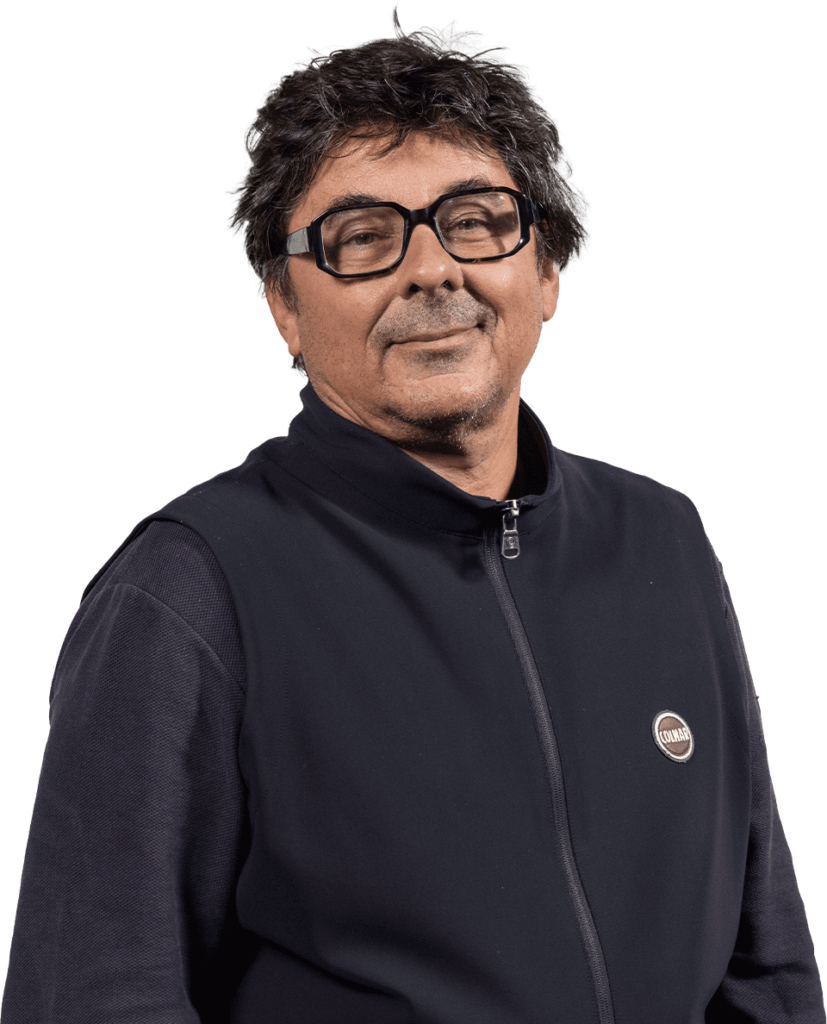
Franco
Ripa di Meana
I started out on stage, as an actor with Giorgio Barberio Corsetti in 1984 at the Venice Biennale; I then moved behind the scenes, working as an assistant director at the Teatro alla Scala, and later at leading Italian and European theatres and festivals, collaborating in particular with Luca Ronconi and Graham Vick. I moved beyond the curtain, directing my first production in 1991 at the Teatro San Carlo in Naples, and subsequently directing for some of Italy’s most important theatres (Turin, Florence, Palermo, Rome, Venice, Spoleto, Reggio Emilia, Parma, Trieste, Bologna, Genoa, Macerata). In 2006, I returned to the Scala with one of my productions, and in 2010, I found myself at the NCPA in Beijing. I took a step back and found myself producing OPERAOGGI, Italy’s first opera touring company (over forty performances in squares, quarries, theatres, parks and industrial archaeology sites across five different Italian regions). Then, taking a sideways step, I became the librettist for Nicola Sani’s opera ‘Falcone, il tempo sospeso del volo’, which has already had three different productions and was broadcast on RAI 5 on the thirtieth anniversary of the Capaci bombing. I began to look at things from a different perspective, teaching (Conservatorio di Santa Cecilia, Scuola dell’Opera Italiana in Bologna, IUAV University, Academies of Fine Arts in Carrara, Turin, Brera and Rome). Bringing together my entire career, I recently curated The Prague Experiment (Award for Imagination at the 13th Prague Quadrennial) and The Milan Experiment (the inaugural project of Brera Accademia Aperta), which attracted 3,000 visitors in five days (www.imaginometricsociety.com). I am currently leading a HORIZON 2020 research project (EU4ART_differences, Work Package 4) aimed at creating a digital ecosystem for creative knowledge, which involves the Academies of Rome, Dresden, Riga and Budapest, the Polytechnic University of the Marche and the Department of Architecture of the University of Florence. I run a blog dedicated to the ketogenic diet for epilepsy (www.ketogourmet.blog).
THREE-YEAR COURSE
Expected outcomes
- Understanding of the complexity of production for theatre/film/major events
- Identification of the main professional roles and workflows
- Ability to analyse a script from a production perspective
Topics covered
Defined spaces: the set, the stage, the television studio.
Professional roles and workflows.
The directing project: from the commission to sharing it with the audience.
Organising time, organising people: production schedules, rehearsal schedules.
Dramaturgical text and performance text.
Text structure: the basic elements and the overall structure.
Call sheets, lists, director’s notes.
Production management: what it means and who does it.
Organisation of the stage/set: rehearsals, documentation, requirements.
Creative roles: project, presentation, production.
Support roles: casting, location manager.
Liaison roles: assistants, production assistants, assistant directors, second units.
Organisational roles: scheduling, department coordination.
Executive roles: stage manager, cueing, assistant director.
Production roles: scenography workshops, prop department, costume department.
Management roles: stage set-up, artistic direction, management.
Public relations roles: press office, social media, box office, venue, invitations.
Administrative roles: compliance, payroll.
FOCUS 1: Basic principles of lighting design
FOCUS 2: Basic principles of filming (shots and transitions)
FOCUS 3: The main acting techniques
Texts analysed
- Mank, by J. Fincher
- Don Giovanni, by L. da Ponte and W. A. Mozart
Call sheets, production lists, set change lists.
Teaching structure
Group assignments to be completed during the lecture (on TEAMS).
Assignments for the next lecture.
Exam
To be admitted to the exam, students must have attended the course and participated in the work carried out during lectures.
Assessment criteria
Participation in the course: 15/30
Oral exam: 15/30
Reading list
-
S. Scafidi: Gli strumenti della regia (vols 1+2) – Dino Audino, Rome 2020 ISBN 9788875274504; €15
- F. Scanu: Accanto al regista – Dino Audino, Rome 2019 ISBN 9788875274245; €13
- C. Grazioli: Luce e ombra – Laterza, Rome and Bari, 2008 ISBN 9788842086475; €11
- L. Allegri: L’artificio e l’emozione – Laterza, Rome and Bari, 2009, ISBN 9788858114889; €11
First semester
THURSDAY 2:00 pm – 7:00 pm, ROOM 205 + TEAMS: ici0nz6
N.B. To attend lectures (including in-person lectures), you will need to:
• Bring a computer or tablet to connect to Teams.
• Register a profile on the MIRO platform (www.miro.com) using your university email address; the profile is free of charge and will allow you to create three boards.
THREE-YEAR COURSE
Expected outcomes
- Awareness of and control over the metaphorical process of storytelling
- Control of dramaturgical signs and of the relationship with the user
- Development of the ability to transform and evolve the narrative core
Topics covered
Dramaturgical signs: what they are and what functions they serve.
Timeline: time as sequence / time as duration.
Weak heuristics and selection operators.
The narrative core. Communicating a narrative core.
The dramatic canon: Aristotle’s Poetics.
The act of seeing and catharsis.
The horizon of expectations and the suspension of disbelief.
Genres
Mediators: actoriality and performativity.
The space of performance and dramaturgy.
Black box and white box: spectator versus visitor.
Dramaturgical text and performance text.
The text: core elements and overall structure
Teaching structure
Theoretical lectures; group work during lectures; assignments for the following lecture; presentation of exercises to the class (pitch session); regular reviews.
Practical exercise
Construction of a linear narrative (theatre, video, performance, comic strip, photography, etc.).
Project / possible production.
Narrative core – transitions – narrative arc – character introductions.
Plot, narrative arc and narrative direction.
The exercise can be carried out either individually or in a group (max. 5 students).
Texts analysed (2022/2023 academic year)
DUNE – by J. Spaihts, D. Villeneuve, E. Roth
WEST SIDE STORY – by T. Kushner
THE MARRIAGE OF FIGARO – by L. da Ponte and W. A. Mozart
Examination
To be admitted to the examination, students must have completed the revisions and submitted all practical exercises by the end of the lecture period; for subsequent examination sessions, practical exercises must be submitted at least one week before the examination; in the second semester, it will be possible to undertake revisions.
Assessment criteria
Coursework: max. 10/30
Tutorial: max. 10/30
Oral examination: max. 10/30
Reading list
The oral exam covers the study of four texts:
- Aristotle: Poetica – Dino Audino, Rome 2018; ISBN 978-88-752-7378, €18. (Any edition of Aristotle’s text is acceptable)
- M. Fazio: Regie Teatrali – Rome, Bari: Laterza, 2009, ISBN 978-88-420-8990-2, €20
alternatively
T. Elsaesser, M. Hagener – Teoria del film – Einaudi, Turin 2009 ISBN 978-88-06-19626-4; €20- K. Mitchell: Il mestiere della Regia – Dino Audino, Rome 2017 ISBN 978-88-752-7365-1; €22
alternatively
M. Lombardi: Fuck the continuity – Dino Audino, Rome 2010 ISBN 9788875271831; €17- A.M. Monteverdi: Leggere uno spettacolo multimediale – Rome, Dino Audino 2020 ISBN: 9788875274467 €18
alternatively
S. Scafidi: Gli strumenti della regia (2 volumes) – Dino Audino, Rome 2020 ISBN 9788875274504; €15 - K. Mitchell: Il mestiere della Regia – Dino Audino, Rome 2017 ISBN 978-88-752-7365-1; €22
First semester
MONDAY 14:00 – 19:00, ROOM 8CB + ONLINE / TEAMS: 2f9t1a7
N.B. To attend lectures (including in-person lectures), you will need to:
• Bring a computer/tablet to connect to Teams
• Register a profile on the MIRO platform (www.miro.com) using your university email address; the profile is free of charge and will allow you to create three boards.
TWO-YEAR COURSE
Expected outcomes
- Integration of the viewer into the creative process
- Control over the criteria for generating material
- Ability to manage multiple narrative strands simultaneously
Topics covered
Storytelling beyond the dramatic form.
The pioneers: Brecht and Piscator.
The post-dramatic as a critical category for interpreting contemporary practices.
The device: from repetition to generation
Audience freedom.
Directing in the age of Artificial Intelligence.
Technology and authorship: deepfakes, AI and gaming.
Mirror neurons: empathy and predictability.
Practical exercises
The course includes two practical exercises:
- Creation: Design and production of a post-dramatic device.
Carried out in groups of up to 5 students, or individually. - Performance: Jon Fosse: Caldo.
Carried out individually – weekly submissions.
Teaching method
Lectures; group tasks to be completed during the lecture on the TEAMS platform, followed by discussion; case study: collective presentation of a case study; analysis of weekly submissions; collective presentation of projects to the class (pitch session).
Reading list
The oral exam covers the study of four texts:
- H. T. Lehmann: Il teatro Postdrammatico – Cue Press, Bologna 2017 ISBN 978-88-99737-46-7; €33
alternatively
R. Shechner: Introduzione ai Performance Studies – Cue Press, Bologna 2018 ISBN 9788899737818; €48- L. Manovich: L’estetica dell’intelligenza artificiale – Luca Sossella 2020 ISBN 9788832231298: €10
alternatively
G. Agamben: Cos’è un dispositivo – Nottetempo, Milan 2006 ISBN 9788874528202; €4 / e-book €1.99- V. Gallese, M. Guerra: Lo schermo empatico – Raffaello Cortina, Milan 2015 ISBN 978-88-6030-776-7; €21
alternatively
HumaniTies and Artificial Intelligence, edited by F. P. Grunert – Noema Media and Publishing 2022, downloadable from this link- Edited by C. Mu, P. Martore: Performance Art – Castelvecchi, Rome 2018 ISBN 97888694446092; €22.80
Alternatively
B. Groys: In the flow – Postmedia Books, Milan 2018 ISBN 9788874902002; €18
alternatively
D. Quaranta: Surfing with Satoshi – Postmedia Books, Milan 2021 ISBN 9788874903030; €22.80 - L. Manovich: L’estetica dell’intelligenza artificiale – Luca Sossella 2020 ISBN 9788832231298: €10
N.B.: Instead of one or more of these texts, students may also choose from the following reading list in English:
- M. Carlson: The Haunted Stage. The Theatre as a Memory Machine, University of Michigan Press – ISBN 978-0-472-08937-6
- The Twentieth-Century Performance Reader, edited by M. Huxley and N. Witts, Routledge, New York 1996 – ISBN-13: 978-0-415-25286-7
Examination
To be admitted to the exam, students must have completed the revisions and submitted all tutorials by the end of the lecture period; for subsequent exam sessions, tutorials must be submitted at least one week before the exam; in the second semester, it will be possible to undertake revisions.
Assessment criteria
Exercise 1: max. 10/30
Exercise 2: max. 10/30
Oral exam: max. 10/30
First semester
WEDNESDAY 14:00 – 19:00, Room 205 + ONLINE / TEAMS: e3f9t9x
N.B. To attend the lectures (including in person), you will need to:
• Bring a computer or tablet to connect to Teams
• Register a profile on the MIRO platform www.miro.com, using your university email address; the profile is free of charge and will allow you to create three boards.