Novella
Oliana
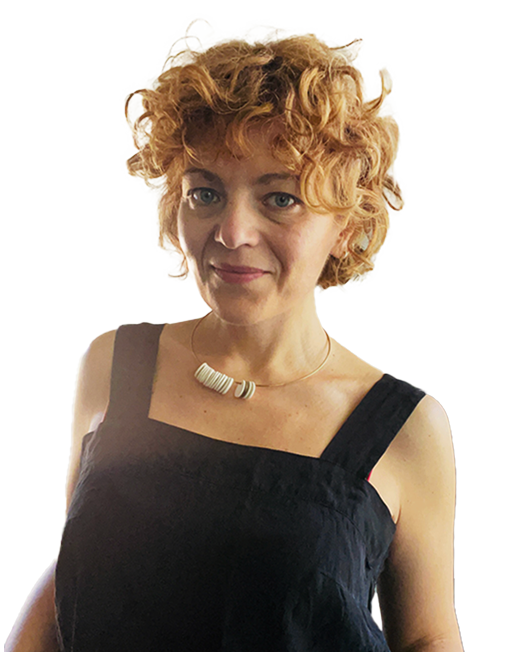
Novella Oliana (Trani, 1978) is a visual artist, lecturer and researcher. She has an initial education in cultural studies, with a focus on the Mediterranean and the Middle East (Università di Napoli L’Orientale, Italy), and holds a practical–theoretical PhD in Visual Arts (Université Aix-Marseille, France), co-supervised by Mario Cresci.
Her research-creation work initially focused on the representation of the Mediterranean and its imagery, analysing the sea as a heterotopic and allegorical border territory. Her approach has increasingly focused on the evolution of the medium of photography in contemporary culture, as well as on the use of archives/documents as an artistic practice. Grounded in a transdisciplinary way of thinking, she focuses on speculative gestures and narratives as means of reimagining territories and transforming ways of thinking about and inhabiting the world, thereby fostering a political and cultural approach to art. In her work, she employs a variety of media, from video to objects, drawings, sculptures and installations.
Her works have been displayed in Italy and abroad in group and solo exhibitions, including: Stanze Spazi Universi, Italian Cultural Institute in Marseille (2018); Cartografia performativa del Mediterraneo, Arcoscenico-Numero Cromatico (2020); Lo spazio necessario, joint solo exhibition with Mario Cresci (Red Lab Gallery, 2020); Lo spazio necessario, f4 Festival, Fabbri Foundation (2022). She is the winner of the 2021 New Post Photography Award (Mia Photo Fair).
Her most recent publications as an author include: 2020, ‘The Mediterranean surface and the archetype of the island as contemporary paradigms for accessing cultural commons’, in Cultural Commons and Urban Dynamics. A multidisciplinary perspective, University of Catanzaro, (eds Macrì, Morea, Trimarchi), Springer Edizioni; 2020, ‘Fra noi e le cose’; 2018, ‘Chambres, univers: fragments d’un espace inventé. Photographie, interférence et récit dans la représentation d’un lieu liminaire’, in Espaces d’interférence narrative, Art et récit au XXI siècle, ed. Jean Arnaud, Bruno Goosse, PUM University of Toulouse. Her work has appeared in numerous books, catalogues, and print and online magazines, notably in the following recent publications: 2018, ‘What I need to be myself elsewhere’, in Il sangue delle donne. Tracce di rosso sul panno bianco, edited by Manuela De Leonardis, Post-media Books; 2020, ‘Mario Cresci e Novella Oliana’, by Gigliola Foschi, in Gente di Fotografia; 2020, ‘Cartografia performativa del Mediterraneo’, in Arcoscenico, catalogue of the project and exhibition curated by Numero Cromatico, Rome; 2022, ‘Possibili idee di mare’, in Il corpo solitario. L’autoscatto nella fotografia contemporanea, (ed. Giorgio Bonomi), Edizioni Rubbettino.
Course focus:
This practical and theoretical educational programme examines photographic documentation in relation to its wide range of applications and the multidisciplinary interactions it establishes. Therefore, the course aims to familiarise students with the complexity of the unique and pivotal role played by photography and to help them understand the nuances of visual metalanguages in relation to contemporary communication.
Methodology and objectives:
The course will be divided into three main sections, during which, using a theoretical and practical approach, students will be invited to explore key aspects of the concept of photographic documentation: starting with the meaning of ‘document’ in photography, the course will examine its importance in relation to visual communication throughout history, analysing the relationship between image and text. Particular emphasis will be placed on the importance of decolonising the gaze, by examining the relationship between photography and the documentation of places, bodies and their habitus. The role of archives and the creation, through photography, of ‘imaginary museums’ as repositories for the dissemination, understanding and representation of reality will be defined. Finally, we will explore in depth the relationship between photographic documentation, the visual arts, and its interaction with the transmedia nature of contemporary storytelling.
Output:
Each student will be encouraged to regularly produce presentations, research and documentation with the aim of creating a curated archive; this archive will take the form of a maquette, the result of the class workshop’s research process. The ultimate objective of the educational programme is to provide students with the technical and conceptual tools to navigate the complexity of the metalanguages of photographic documentation and their current use.
Bibliography:
BENJAMIN, Walter, The Work of Art in the Age of Its Mechanical Reproduction, Turin, Einaudi, 2014.
BORDIEU, Pierre, Un’arte media. Saggio sugli usi sociali della fotografia, Sesto San Giovanni, Meltemi, 2018.
CRESCI, Mario, Misurazioni. Fotografia e territorio. Oggetti, segni e analogie fotografiche in Basilicata, Rome–Turin, Yard Press, 2020.
FLUSSER, Vilém, Per una filosofia della fotografia, Milan, Mondadori, 2006.
HEIFERMAN, Marvin, La fotografia cambia tutto, Milan, Contrasto, 2013.
MOHOLY-NAGY, Laszlo, Pittura, fotografia, film, Turin, Einaudi, 2010.
During the course, lecture notes will be distributed in Italian and English, which are to be considered compulsory.
Additional references (websites, filmographies, catalogues, etc.) recommended for further study and research will also be provided.
Two-Year Photography and Video Programme
Course focus:
This practical and theoretical teaching programme examines photographic documentation in relation to its multidisciplinary interactions, with a particular focus on the representation of a ‘territory’ (enclosed space, research space, place). Therefore, the course invites students to become familiar with the complexity of the unique and decisive role played by photography and to understand the nuances of visual metalanguages in relation to the perception of the body and space.
Methodology and objectives:
Using a theoretical and practical approach, this course requires students to explore in depth the concept of the contemporary document: its importance in relation to the interaction between reality and virtuality will be examined, analysing the relationship between image, simulacrum, object and space. Particular emphasis will be placed on the importance of an ecologist approach to contemporary imagery, with a focus on transdisciplinarity. Focusing on the concept of decolonising the gaze, the course will examine the relationship between photography and the documentation of places, bodies and their habitus. The role of the document will be defined in terms of its agency, as a research and creative tool for the dissemination of new ideas, knowledge and the representation of reality. A number of artists will give talks during the lectures, and various visits to archives and art venues will be organised. Finally, the relationship between photographic documentation, the visual arts and the possibilities for re-mediation offered by contemporary media will be explored in depth.
Output:
Each student will be invited to regularly produce presentations, research and documentation with a view to creating a well-considered group project. From time to time, the research will take the form of a small project, the result of the class workshop’s research process. Finally, students will work on an individual project, drawing on the technical and conceptual tools provided, to navigate the complexity of the metalanguages of photographic documentation and their current use.
Bibliography:
Compulsory readings:
CALVINO, Italo, Le Cosmicomiche, Milan, Mondadori, 1993.
GRECHI, Giulia, Decolonizzare il museo. Mostrazioni, pratiche artistiche, sguardi incarnati, Milan, Mimesis, 2021.
HARAWAY, Donna, Chthulucene. Sopravvivere su un pianeta infetto, Rome, Nero, 2019.
INGOLD, Tim, Making: Antropologia, archeologia, arte e architettura, Milan, Raffaello Cortina, 2019.
Recommended reading:
BUTLER, Judith, The Alliance of Bodies, Milan, Nottetempo, 2023.
ECO, Umberto, Opera aperta [1962], Milan: Bompiani, 2009.
NEIMANIS, Astrida, Bodies of Water: Posthuman Feminist Phenomenology, Bloomsbury USA Academic, 2019.
During the course, lecture notes will be distributed in Italian and English; these are compulsory.
Additional references (websites, filmographies, catalogues, etc.) recommended for further study and research will also be provided.
Focus:
This teaching proposal focuses on the digital image and its hybridisations in contemporary meta-photographic approaches, and aims to structure a comprehensive research-creation pathway, reflecting on the cultural and political significance of photography in society.
Methodology and objectives:
The first phase of the course focuses on the evolution of the photographic image and the processes of its dematerialisation. Through practical workshops and in-depth theoretical study, the aim is to encourage students to reflect on the transformation, brought about by digital technology, of the ontological perspective of the image and its pragmatic perspective, relating to its cultural and social functions. Students will examine the ways in which the photographic image contributes to redefining contemporary artistic practices, creating spaces of indeterminacy and visual-narrative interference. In a second phase, we will analyse the use and dissemination of images: the focus will be on the role of contemporary devices and, in particular, on the screen as a haptic medium capable of connecting vision with space and the body, thereby shaping new processes of interpretation and representation of reality.
Outcome:
The educational programme aims to guide students to reflect on the transdisciplinary nature of contemporary imagery and the relational aesthetics it generates, directing their work towards the multiplication of perspectives, tools and the role of the contemporary visual author. Each student will be encouraged to regularly produce presentations and research, and will be guided in creating their own visual journey.
Bibliography:
Compulsory texts:
CALVINO, Italo, Six Memos for the Next Millennium, Six Memos for the Next Millennium, Milan, Garzanti, 1988.
CRESCI, Mario, Forse Fotografia, Turin, Allemandi & C., 2012.
ECO, Umberto, The Open Work [1962], Milan, Bompiani, 2009.
INGOLD, Tim, Making. Anthropology, Archaeology, Art and Architecture, Milan, Raffaello Cortina, 2019.
MERLEAU-PONTY, Maurice, The Visible and the Invisible [1964], Milan, Bompiani, 2007.
STEYERL, Hito, The Wretched of the Screen, Berlin, e-Flux Journal, Sternberg Press, 2012.
ZANCHI, Mauro, La fotografia come medium estendibile, Milan, Postmedia Books, 2022.
During the course, lecture notes will be distributed in Italian and English; these are to be considered compulsory.
Additional references (websites, filmographies, catalogues, etc.) recommended for further study and research will also be provided.