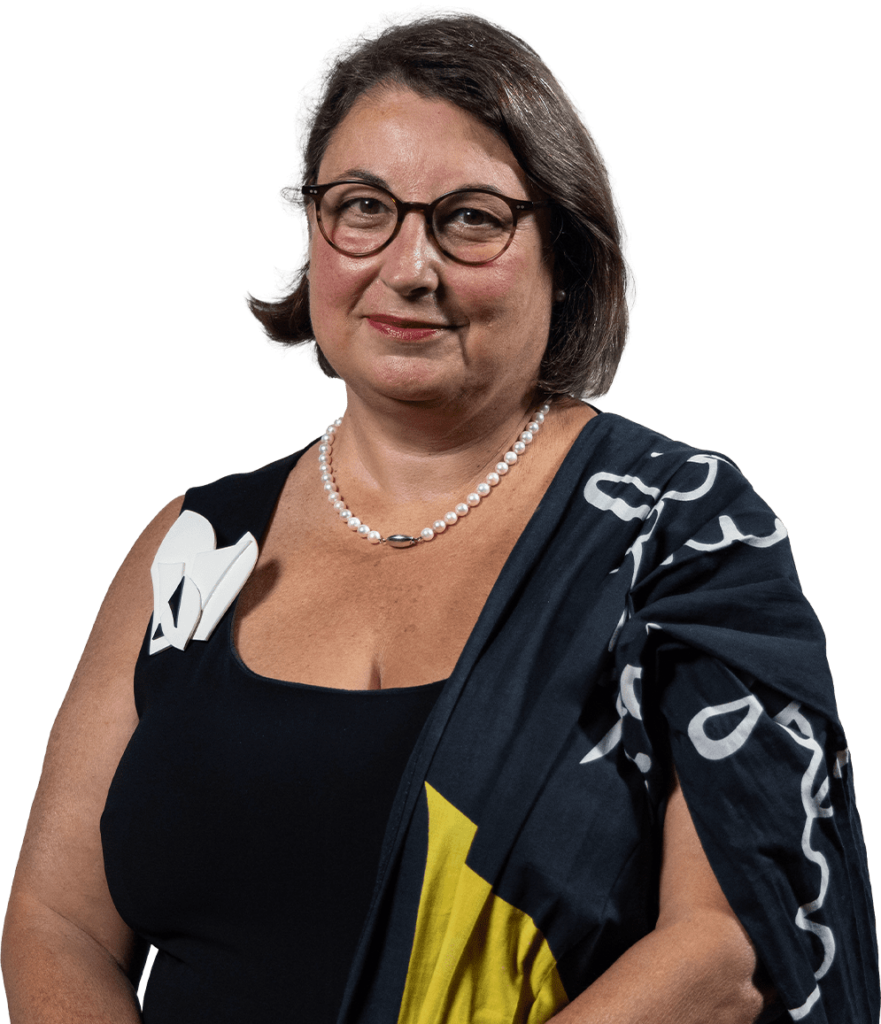
Alessandra Maria
Porfidia
Professor and coordinator of the School of Sculpture at the Academy of Fine Arts in Rome, where she trained.
She has been exhibiting in Rome since 1980 and works with various international galleries, having made her debut at Carmine Siniscalco’s gallery, “Studio S Arte Contemporanea”, and, since 2005, with Bozzini’s Galleria Edieuropa.To find out more about Alessandra Maria Porfidia, please see the PDF:
The richness of art is revealed in its ability to develop the imagination and to transform. Art is not a phenomenon that requires an explanation; instead it is a method of research.
Throughout the educational programme, the course approaches the work while respecting and exploring individual sensibilities.
For the student, as well as for the Artist, certain questions are fundamental
- .
- What to do?
- How to do it?
The “way” in which the material is handled alters its meaning. This is why the sculpture manages to embody the concept by taking shape in a tangible, material form. The function of sculpture is to stimulate new ways of seeing, new sensory attitudes, and to invent and interpret space in a new way. In Sculpture, the key elements are material and form, which play a central role. The quality of the material and the specificity of the form create something unique. Perception is the first fundamental act that takes place, both internally and externally. The eye and the hand are closely connected, just as our brain and our body are; that is why, through the process of doing, we discover things and learn about ourselves and the world.
Art is a daily challenge that seeks transformation and exploration. What is the origin of the research? Which is more important: the Idea or the Imagination? What is Vision? Which is more important: sensitivity to the material or technology? What relationship does the work establish with Time? Some of the questions the course addresses in an attempt to find answers and generate new ideas.
The three-year Sculpture Course aims to foster knowledge of techniques and explore the concept of plastic art through the immersive experience of the workshop. Working on methodologies and technologies, on the concept of “Poetics” and on “Language“. The course addresses some of the fundamental questions for artists: the concepts of Space, Matter, the study of Action, Imagination, Perception, Synaesthesia, Tactility, the concept of the Void, the Solid, the Body, the Relationship. These key questions are gradually explored individually by the students, with the support of the lecturer. The course introduces students to sensory awareness through direct experience with materials, the analytical study of the creative process, and the proposals and projects developed in class. A strong point of the course is its wide range of external workshops, meetings with artists, and practical activities of a technological and technical nature at companies within the sector, which are key players in various technological fields: metal fabrication, foundries, terracotta and ceramic kilns, marble quarries and sawmills, stone workshops, plastics manufacturers, etc. The teaching approach is designed to support individual development; accordingly, it helps students to develop carefully selected creative and experimental choices, encouraging them to take risks by engaging with each topic and their own sphere of activity or relationships.
The course aims to bring students closer to the real world of art through events, exhibitions, talks, workshops, interdisciplinary teaching and external labs. This range of opportunities provides students with the chance to develop professionally.
The educational value of this three-year Sculpture course lies exactly in the openness and fusion of language through integrated academic and practical modules. The students have the opportunity to explore different areas of research, enriched by international experience. The course offers a wide range of interdisciplinary opportunities, projects and external collaborations.
From workshops to the complete realisation of museum-quality exhibition proposals. In line with the spirit of openness and exchange that characterises the course, students’ education is at the heart of an ongoing commitment to engage in international institutional activities across various areas of activity: Erasmus+, Eu4Art and UNIMED.
Over the course of the three-year programme, students are encouraged to learn to work simultaneously on different levels and in different ways, in order to enhance their educational experience. In other words, while students continue to study from life through drawing and modelling as a foundational exercise, from the very outset the course begins to equip students with the tools needed to develop critical awareness and experimental initiative. Focusing on a critical-practical analytical methodology, in response to a vairety of thematic and programmatic proposals provided to the students. Some recurring themes in the research include: Art between Artifice and Nature, Sustainability, Beauty, Interior/Exterior, the theme of Time and impermanence, the organic and inorganic body, light and shadow, etc. Even if a piece appears to be finished, this does not mean it is truly complete; for this reason, it is necessary to develop an analytical approach that identifies the work’s strengths and weaknesses. The eye must always establish a dynamic relationship with the sculptural work. Today, we are experiencing a very strong push towards the immediate codification and commodification of products, but the artist’s task is to establish additional criteria that are unconstrained, free, imaginative and creative. The aim of the course of study is to foster the ability to establish a vital relationship with the work by seeking new values and new meanings in step with our times.
TEACHING METHODOLOGY
- Experimental and analytical experience. Analysis of expressive languages, across the broadest spectrum of sculpture-making. The course takes a practical and analytical approach, both conceptual and visual.
- The course offers students a variety of research paths, aligned with their individual aspirations and open to the possibility of new discoveries; therefore, the work is created as a dynamic work in progress.
- Study of Perception, Analysis and Vision: an introspective and external analytical pathway.
- Experimentation with and knowledge of materials (differentiating them according to their specific properties and poetic qualities): modelled sculpture, metal sculpture, assemblage, recycled materials, natural materials, new technologies, casting, terracotta, next-generation plastics, natural materials, fibres, and much more. Experimental knowledge forms part of the scope of sculptural research and experimentation within the three-year sculpture course.
- Working on the concept
- Learning a research methodology. Knowing how to move within space with awareness, learning to operate inside and outside the rules, in a way that is as visionary as it is self-aware
- Understanding the importance of the concept of scale and studying space
- The course aims to stimulate students within the creative experience and to sensitively develop their professional skills and individual aptitudes.
- Students will be encouraged to study the figure from life, which encompasses the grammar of form and space, as well as the study of geometry, line, boundary, material, surface, volume, statics, movement and light.
- The training programme involves the creation of free-form sculptures through the development of projects, sketches, the gathering of materials and targeted sensory experimentation. Study and creation of works in relation to environmental, urban and natural contexts
- Study and production of traditional, technological and multimedia sculptural works, site-specific installations, and natural and sustainable works for public exhibitions.
- Exploration of new expressive languages tailored to specific objectives and client requirements.
- Experimentation aimed at achieving professional maturity through advanced artistic training.
- Development of a professional portfolio and a strong artistic identity.
- Participation in competitions, exhibitions and other opportunities
.
.
.
- WORKSHOP PRACTICE / PRAXIS
- Analytical practical study
- Work on Perception
- Study of basic sculptural concepts: form, space, light, matter, negative space, positive space, time, movement, action.
- Clay modelling, plaster moulding, casting and experimentation with a wide range of contemporary materials.
- Free expression and enhancement of individual creativity
- Group and interdisciplinary work
- Life drawing
- Graphic study and design
- CONCEPTUAL RESEARCH/POIESIS
- Visits to Exhibitions
- Meetings with artists
- Webinars
- Artistic residencies
- Travel
- Visits to Museums and Foundations
- Theoretical insights
- An analytical study of the works of historical and contemporary artists
- Participation in public and private competitions
- In-depth theoretical study
- Research references: Miro Conceptual Map
- Critical references and reading list
- Reading texts, both classical and recent, stimulates debate on a wide range of topics and becomes the subject of discussion and study, thereby laying the cultural foundations for approaching one’s own work in a professional manner.
- LIST OF WORKSHOPS (Academic, National and International)
- External educational experiences: Workshops, Symposiums, Festivals, Exhibitions, Art Fairs: Italian Embassy in Athens, Academy of Fine Arts in Budapest, Academy of Fine Arts in Dresden, Academy of Fine Arts in Riga, Narni Sociology Festival in collaboration with the Minerva Arte Association and the University of Perugia, Seminare Arte Thuya Lab APS.
- External workshops: Carrara Marble Quarries, Tinos, Cyclades, Marble Workshops. SEFIN Metal Fabrication – Montecastrilli-
- Meetings with international artists
- Public sculpture projects: Botanical Garden Museum in Rome, Gardens of Villa Reale in Monza, Gardens of Villa Verri in Biassono, Historical Gardens of San Quirico d’Orcia, Laboratorio della Mente Museum, Marble and Craft Pyrgos – Tinos (Greece), Bortolotti Auditorium in Narni
PORFIDIA THREE-YEAR SCULPTURE COURSE “SUSTAINABLE IMAGINATION”
Project themes:
- LO SGUARDO DELL’ALTRO
- MEDITERRANEAN – MED ART PROJECT
- SCULTURA TRA SOSTENIBILITA’E TECNOLOGIA
- VEDERE DIVERSA-MENTE
- SCULPTURE – SUSTAINABILITY – RECYCLING
- FROM MATERIAL TO WORK OF ART
- MAN AND NATURE – SCULPTURE AMIDST GREENERY
- ART TO BE EXPERIENCED
- INTERNO7ESTERNO
- BODY AND MIND
Educational objectives:
The objective of the Second-Level Diploma Course in Sculpture, Public and Environmental Art is to provide a research methodology and creative training, including technical and analytical skills relating to the specific codes of expression. The learning pathway offers various levels of exploration: the analysis of the forms that characterise the typology of Public Art and the study of its function in relation to private art. To understand the complex evolution of contemporary artistic language, which is the result of significant cross-fertilisation; to explore visionary approaches to engaging the viewer in an appropriate relational dynamic, both in urban settings and in natural environments. Through direct experience of experimentally exploring space in its most varied forms and using different materials, the course addresses a range of issues. Focusing on the most pressing issues of our time, the course explores the diverse practices and poetics expressed by Public and Environmental Sculpture, offering a range of imaginative solutions across different geographical and environmental contexts. The course aims to stimulate the development of knowledge in a variety of ways, through the dialectical experience of the sculptural work, situated between artifice and nature, between architecture, space and social contexts. It addresses the context and the public function. Through the analytical study of contemporary works and artists, students in training are provided with a lens for interpreting symbolic space, which is considered on a case-by-case basis, to highlight its poetics and the specificity of its language. The course prepares students to discern the characteristics of language and originality in individual contemporary artistic practices and methodologies. In this way, the course of study creates the practical conditions to foster a stimulating dialogue and helps students to develop new poetic solutions with a social, public, ethical and innovative dimension.
Every era has brought about a shift in language and its symbolic perception; today, the concept of contemporary space involves various areas of influence, amplified above all by the use of new technologies. Through an integrated approach combining theoretical and practical study, students undertake a training programme that aims to harness creative influence and multidisciplinarity within the specific field of sculpture. The study begins with workshop experiences in outdoor settings, from the Botanical Garden to the public park, the town square and any other place that can serve as the subject of creative exploration. Research must always be integrated within a practical project framework, aligned with the need to bring into play a highly contemporary vision. The central theme around which the entire training activity revolves is the development of creative and professional expertise, as reflected in public sculpture.
Practice and technical study, together with field experience, combine to enable students to acquire a research methodology and an awareness of design practices and the requirements of a creative language in step with the times.
Following an educational path designed to provide in-depth knowledge of theories, materials and technological tools, the course aims to develop, in a varied and unique manner, the ability to interpret the complex phenomena related to the art world, its contexts, its dissemination, the interpretation of reality, and the contemporary era. Each year, the course offers an updated reading list covering the topics addressed: from emptiness to memory, to issues of visibility, aesthetics and new technologies.
The course makes use of the strategic role of the workshop, which is designed as a place for the exchange of experiences. Starting from a foundational training programme that structures creative thinking through dialogue, reading, reflection and work in progress, as well as drawing and the manipulation of materials, students progressively explore the thematic universes that interest and motivate them, as well as those proposed by the lecturer as project topics and research opportunities. External workshops at companies specialising in the various technical fields enable students to gain first-hand experience and to orient themselves consciously in relation to the different practices, while also developing new applications and new operational criteria.
The workshop programme is highly impactful, offering research and experimentation opportunities of broad interest. Indeed, a distinctive feature of the course is this outward-looking research approach, involving fieldwork in museums, open-air museums such as the Botanical Garden Museum in Rome, international museums abroad, such as the Marble & Craft Museum in Pyrgos on the island of Tinos in Greece, the Italian Embassy in Athens, at foreign academies, public venues such as the Villa Reale in Monza, the Villa Verri in Biassono, the historic Villa degli Horti Leonini in San Quirico d’Orcia, and numerous other venues and exhibition spaces.
Methodology:
The Public Art Sculpture specialisation offers a study programme focused on the poetics of space, understood as a relational place and an environmental habitat, both urban and natural. At the heart of the artistic research lies knowledge of sculptural technologies applied to public spaces, the study of the requirements of public sculpture, and the environmental function of sculptural works. Knowledge of the basic rules for participating in public art competitions where the inclusion of sculptures, commemorative monuments and other landmarks in squares, public buildings, roundabouts, urban gardens and other locations is required. These sculptural works must serve as cultural references within the context for which they are designed, and may also have highly significant effects on a relational, social, economic and environmental level. The 2% law represents one of the most significant opportunities for artists wishing to create works of public art.
Specific issues, in the design of public sculpture are: durability, safety, stability, sense of scale, maintenance, relationship with the environment, sustainability, and, of course, aesthetic value. From the design phase through to its realisation, a thorough understanding of materials and the various possibilities for using technology is essential. The contemporary focus of the course is enhanced by practical experience in various research areas through workshops, environmental design projects, the study and creation of works for public spaces, multi-site exhibitions, and site-specific installations.
Participation in public sculpture competitions, symposia and artist residencies is essential, as these provide opportunities for field research from a perspective that can sometimes stimulate new methodological approaches and an understanding of other artistic languages. The relationship with technology, urban planning, architecture, the environment and nature is a topic of study. With regard to the theoretical component of the study of Environmental and Public Sculpture, it is crucial to establish in-depth study pathways with art historians, philosophers, architects, technicians and other professionals who can make a qualitatively significant contribution to the specialist training. The aim is also to create opportunities for exchange with other university faculties, both in Italy and abroad. With this in mind, we intend to develop the Mediterranean Med Art Project, particularly in view of the recent inclusion of the Academy of Rome in the UNIMED network. In addition, particular reference is made to the pilot research programme already trialled at European level with the Universities of Dresden, Budapest and Riga as part of the Eu4Art project. Last but not least is the potential for exchange and research opportunities offered to students through Erasmus+. These international ties are all fruitful opportunities for the arts and, above all, for fostering collaboration and exchange in the context of the specialist research carried out during the two-year programme.
It is essential to create a network of knowledge and establish active contact with industries and professionals from different sectors. Participation in symposia. Industry forums, festivals and trade fairs are essential for developing a project with awareness and professionalism. Individual work must also be accompanied by the ability to seize new opportunities through group work. An openness to discussion and exchange, as well as flexibility and the ability to listen, are valuable tools for developing artistic research, even at more advanced levels. Understanding diversity, exploring the cultural roots of other, distant places, and embracing the perspectives of others are essential for creating meaningful and inclusive projects. Global communication is increasingly made up of differences. Participation in competitions is one of the most important opportunities for testing the knowledge acquired during the course.
The techniques covered include: modelling, paper craft, soldering, ceramics, assembly, and the use of innovative, recycled and natural materials, as well as synthetic materials, marble and concrete.
Furthermore, 3D modelling techniques are included in the curriculum and can serve as a valuable tool for creativity and design.
- Theoretical Preparation
- Online and in-person practical sessions, workshops
- Participation in public art competitions, the 2% law competitions and other competitions
: International lectures and seminars
Digital devices and new technologies have changed people and the way they think. We have learned about the strengths and weaknesses of technology through our experience of online learning. Today, we are more aware and better able to channel our aptitudes, partly thanks to this lesson. We have new tools that we can use without giving up the fundamental aspects of our “being sensitive and free individuals”. Therefore, the objective of the course is to help the student interpret technology with awareness and creativity. Creativity must always explore new avenues and seek expressive quality. Finding suitable solutions. Conducting research enables us to develop new ideas that technology can help bring to fruition efficiently, particularly when it comes to creating works of any scale. One of the objectives is the transition from projects involving small-scale creations to those on an environmental scale.
The course offers a variety of research paths, starting with an exploration of artists such as those whose names have already become part of art history: Bill Viola and many others who have used digital technology to create expressive forms known as video sculpture, as well as artists such as Studio Azzurro, Fabrizio Plessi, Pipilotti Rist, Tony Oursler and Jaume Plensa, who have employed artistic languages influenced by digital forms and enhanced through the use of new technologies.
The focus of the course is not to undermine intimacy and imagination through the use of technology, but to identify, within new processes, the right potential in terms of language and method to enrich the meaning of the research and individual expressive sensitivity. It is also certainly possible to address collective issues in a way that is sustainable and in harmony with environmental needs, thanks in part to the application of advanced technologies in a project that fosters interaction and sustainable creativity.
In summary, I would reiterate that the aim is to apply new technologies to forms of expression with a powerful emotional impact, without compromising their poetic essence, thereby giving voice to contemporary sensibilities.
A central issue in multimedia and technological art production is the interplay between the Visible and the Invisible.
The core and defining training activities are compulsory courses that develop students’ comprehensive cultural background in the field of applied new technologies. Students thus have the opportunity to acquire skills and work on projects, learning about the various possibilities offered by multimedia operating systems. Students can create projects using 3D digital modelling, design interactive spaces, work on the production of videos and environmental artworks, and explore the concept of video sculpture in depth.
Methodology:
The fundamental skill addressed by the course is the analysis of creative language in its technological application, from both an aesthetic and an expressive perspective. Quality is understood in terms of character, professionalism, style, coherence and visual sensitivity. Distinctive values as opposed to the media and spectacular use of the most popular forms of communication.
Artistic research forms the foundation of the two-year course and aims to prepare students for the professional presentation of their artistic work. To achieve these objectives, an intensive programme of external labs and workshops is essential. Interaction between the lecturer and students takes place through group sessions that continually enhance their knowledge and help them develop new ways of expressing themselves. The research method is based on a proposal from the lecturer aimed at specific objectives: exhibitions, competition projects, and the practical application of various technologies through dedicated workshops. Group collaborations.
Each year, students are required to submit at least three papers and an equal number of research projects, as well as theoretical and summary insights using concept maps to clarify the research from a theoretical perspective.
Reading List:
- Anthony Gormley, Martin Gayford. Plasmare il mondo. La scultura dalla Preistoria a oggi. Giulio Einaudi Editore. Turin 2021
- Giuliana Bruno. Superfici, A proposito di estetica, materialità e media. Johan e Levi editore. Cremona, 2016
- Nicolas Bourriaud, Il radicante. Per un’estetica della globalizzazione, Postmedia books 2014
- Nicolas Bourriaud, Estetica relazionale, Postmedia books, 2010
- Riccardo Falcinelli. Figure. Come funzionano le Immagini dal Rinascimento a Instagram. Einaudi – Turin 2020
- Pietro Montani. Tecnologie della sensibilità. Estetica e immaginazione Interattiva. Raffaello Cortina editore. Milan, 2014
- Byung-ChulHan. Nello Sciame. Visioni del digitale. Nottetempo. Milan, 2015
- Vincenzo Trione. L’opera interminabile. Arte e XXI secolo. Einaudi 2019
“SUMMARY OF THE SUSTAINABLE IMAGINATION PROGRAMME”
- Workshop activities
- Participation in contests
- Participation in international events
- “Sculpture between Sustainability and Technology” –
- Participation in external workshops and laboratories
- Visits to Exhibitions and Museums
- Participation in international forums
- Participation in exhibitions
- Educational and research workshop with industry professionals
- Visit to workshops to study materials and the application of new technologies in sculpture
Career prospects:
All areas requiring expertise in the application of 3D digital modelling, including the use of robotics in marble sculpture, the use of vector graphics for laser cutting and CNC flame cutting, or the use of 3D printers. There are many areas of expertise that can be pursued through this training programme, as part of an innovative approach to art. From virtual tours of museums to digital archives, to a wide range of multimedia projects based on free creativity.
Application of high-tech systems for the creation of free-form environmental sculpture works and the production of multimedia works
Course aims
The aim of the course is to contribute to the student’s education by providing a theoretical and practical methodology that enables them to analyse artistic processes and produce research content.
Course content
The Contemporary Methodologies and Techniques course begins with an analysis of the experiences, languages and media that have accompanied artistic experimentation over recent decades, in order to highlight their specific and contextual characteristics, as well as the dialectical transformation between the work, the artist and the viewer. The course aims to explore the very concept of “Artistic Research” in order to better understand the issue of poetics in relation to the various forms of language. The learning pathway therefore progresses through the analysis of different artistic practices, the techniques employed, and the “mode” of languages and content. The focus of the course is an analytical examination of the work as a product and of the interdisciplinarity between the various expressions of contemporaneity. In particular, the aim is to foster the ability to pursue linguistic freedom, including through the intersection of practices and the fluidity characteristic of contemporary art. Today, fields of research that might seem unrelated are intertwining, and the trend is increasingly towards the blurring of genre boundaries: from physical matter to the immateriality of technology, from performance to mixed-media installations and sound art, and to “relational” art. We must therefore engage with the plurality of practices found in the languages of contemporary art, highlighting the extent to which working methods, procedures, programmes and content are the result of an ongoing process, situated between different sensibilities, social interests, cultural contexts and the technologies involved.
Recommended reading
- Anthony Gormley, Martin Gayford, Plasmare il mondo. La scultura dalla preistoria a oggi. Einaudi, Turin 2021
- Giuliana Bruno. Superfici, A proposito di estetica, materialità e media. Johan e Levi editore. Cremona, 2016
- Nicolas Bourriaud, Il radicante. Per un’estetica della globalizzazione, Postmedia books, Milan 2014
- Nicolas Bourriaud, Estetica relazionale, Postmedia books, Milan, 2010
- Riccardo Falcinelli, Figure. Come funzionano le Immagini dal Rinascimento a Instagram. Einaudi, Turin 2020
- Cristina Casero, Elena Raddo, Francesca Gallo (a cura di), Arte fuori dall’Arte. Incontri e scambi fra arti visive e società negli anni Settanta. Postmediabooks, Milan 2017
- Pietro Montani, Tecnologie della sensibilità. Estetica e immaginazione interattiva. Raffaello Cortina editore, Milan 2014
- Byung-Chul Han, Nello Sciame. Visioni del digitale. Nottetempo, Milan 2015
- Vincenzo Trione, L’opera interminabile. Arte e XXI secolo, Einaudi, Turin 2019
Teaching methods
The course, which comprises theoretical and practical sessions designed to explore the topics in depth, focuses on an analytical methodological approach and the analysis of works of art in order to identify processes and practices that exemplify the key concepts identified as the core of the lectures. The course will be based on open dialogue with and between students, with the aim of fostering a structured and systematic exchange of ideas. From an experimental perspective, specific exercises and methodological guidance will be provided. One of the theoretical workshops offered will involve the creation of concept maps to illustrate analytical and creative research approaches. The course also aims to provide external opportunities to broaden students’ educational experience through workshops and experimental practical sessions, as well as targeted visits.
Assessment method
The final exam will be oral and will cover the various analytical aspects of the topics addressed in lectures.
For the purposes of the exam, students may choose which texts to study in greater depth from the recommended reading list, supplemented by other texts mentioned during the lectures. When awarding marks, the student’s knowledge of the topics covered in depth will be taken into account.